
On 14 November 1781, Scotland’s Court of Session decided a dispute concerning something that had washed ashore on the coast of Sutherland.
The case involved the Reverend Alexander Falconer, minister of Eddrachillis, and his right to gather and profit from seaweed found on the shore adjoining his church lands.
Falconer believed that his position gave him the right to use the seaweed. The landowner, Lord Reay, disagreed.
The minister took the matter to Scotland’s highest civil court.
He lost.
The judgment established that a minister could gather seaweed from the shore of his glebe for agricultural purposes, including manuring his land and feeding livestock, but could not claim a commercial right to the resource.
The ruling survives in the historical records of the Church of Scotland, where Falconer’s unsuccessful legal action is preserved in a brief entry among the details of his ministry.
It is an unusually revealing case from a period when seaweed had become one of the most valuable commodities on Scotland’s western and northern coasts.
Falconer was born in Inverness in 1730 and educated at King’s College, Aberdeen. He received his Master of Arts degree in April 1750 and was licensed to preach in 1757.
After serving as a missionary at Fort Augustus, he became minister of Eddrachillis in July 1763.
The parish extended along a difficult stretch of the Sutherland coast, where small agricultural holdings depended upon the surrounding land and sea.
A minister’s glebe was land traditionally provided to support the office of the parish minister.
In a district where cultivated ground could be thin and unproductive, the right to gather seaweed from the shore was valuable.
For generations, coastal households had used seaweed as fertiliser, carrying it from the shore to fields and small agricultural plots.
But by the middle of the eighteenth century, the same material had acquired an entirely different commercial purpose.
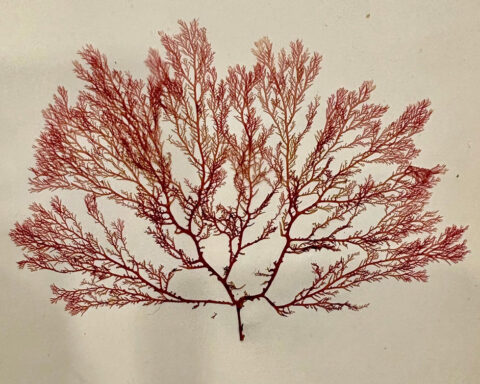
Britain’s expanding glass and soap industries required alkaline substances for manufacturing. One source was an ash produced by drying and burning seaweed.
The resulting material was known commercially as kelp.
The name creates some confusion today because kelp is now commonly used for certain large brown seaweeds. In the historical Scottish industry, the manufactured commodity was the alkaline ash obtained by burning collected seaweed, including the wracks growing along rocky shores.
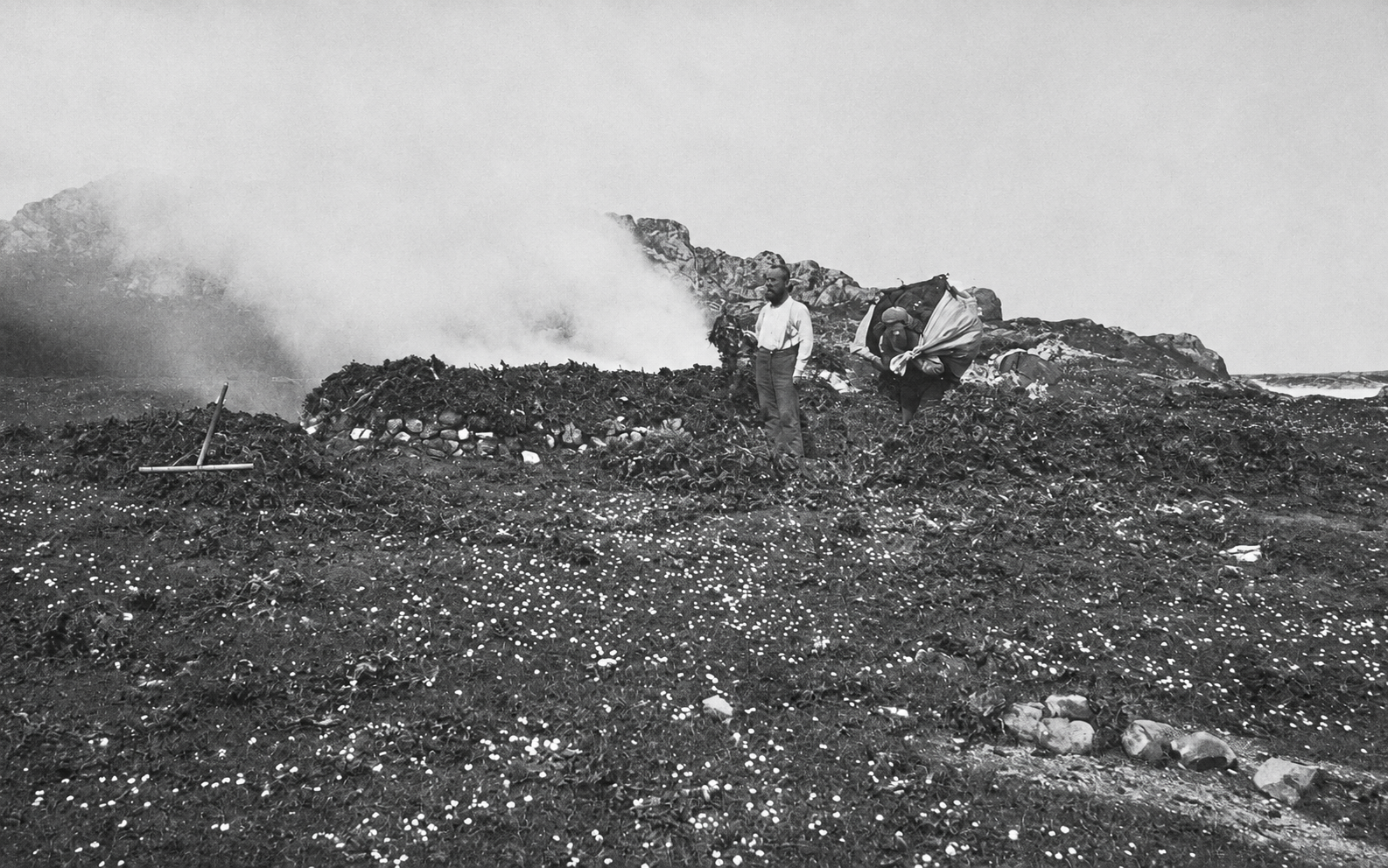
The work involved gathering considerable quantities of wet seaweed, drying it and burning it in specially prepared pits or kilns.
The resulting ash was transported to merchants and industrial customers.
It was demanding work, frequently undertaken by the small tenants and coastal families whose livelihoods depended on their landlords.
As commercial demand increased, ownership of the seaweed itself became a contested matter.
The history of kelp production on the Reay estate illustrates how quickly an ordinary agricultural resource became the subject of leases, contracts and competing claims.
Estate records examined by historians place the earliest references to kelp manufacture in the area during the 1730s.
In 1754, Donald Forbes, a tacksman at Ribigill near Tongue, was entrusted with organising production on the Reay estate.
A decade later, he held a lease covering manufacture in the parishes of Eddrachillis and Durness.
The lease explicitly protected agricultural tenants’ need to gather seaweed for fertilising their land.
That provision reflected the emerging competition between the traditional use of the shoreline and the commercial value of the resource.
By 1773, merchants from Peterhead had become involved.
Among the most prominent was James Anderson, whose business interests and those of his son extended along the northern Sutherland coast.
The merchants established a harbour and trading base at Rispond and arranged leases allowing kelp manufacture along designated sections of the shore.
Their operations included storage buildings at Rispond, Laxford and Kylend.
The commercial arrangements became sufficiently valuable that the leases set out extensive stretches of coast from which seaweed could be gathered and processed.
They also preserved the right of agricultural tenants to take the seaweed required for their own fields.
It was within this changing economy that Alexander Falconer advanced his claim.
The minister occupied a glebe at Upper Badcall. Seaweed found on the adjoining shore could be used to fertilise his land, but commercial kelp production offered a different opportunity.
According to historical research assembled by Ullapool Museum and the North West Highlands Geopark, Falconer sought to use the seaweed for commercial purposes but was challenged by the estate’s ownership arrangements.
He pursued the dispute to the Court of Session in Edinburgh.
The outcome was recorded with unusual precision in the seventh volume of Fasti Ecclesiae Scoticanae, the historical register of Church of Scotland ministers.
The court’s decision of 14 November 1781 limited Falconer’s right to seaweed gathered for the agricultural use of his glebe.
It did not recognise a right to profit commercially from kelp manufacture.
The surviving published account is brief. It does not disclose the full arguments advanced by both parties, their legal expenses or the exact financial value of the seaweed at issue.
It does, however, establish that the commercial exploitation of a coastal resource had become sufficiently valuable to produce litigation between a parish minister and a major Highland landowner.
The industry continued to expand after Falconer’s defeat.
Wars involving France and the disruption of European trade increased demand for British-produced alkalis.
The price of kelp ash rose substantially.
Historical research concerning the Reay estate records prices of approximately £8 per ton during the 1770s, rising to around £30 per ton by 1810.
The figures describe the market for the manufactured ash, not the value of unprocessed seaweed gathered from the shore.
For landowners, kelp manufacture offered an additional source of revenue from coastal property.
For tenants, it provided seasonal employment and income, but it also imposed substantial demands on labour.
The relationship between the two was not necessarily equal.
Estate proprietors and their commercial tenants could control the rights to manufacture and sell kelp. The people gathering, drying and burning the seaweed generally received payment for their labour rather than ownership of the finished commodity.
The dependence of Highland communities on kelp production increased as wider changes in estate management displaced some tenants from inland agricultural holdings towards the coast.
The commercial success of the industry was therefore connected to the social and economic changes that accompanied the Highland Clearances.
By the end of the Napoleonic Wars in 1815, the conditions supporting the kelp trade were beginning to change.
European imports became available again, reducing demand for the more expensive Scottish product.
The industry declined rapidly during the following decades.
On Tiree, where kelp manufacture had begun in 1746, industrial-scale production had largely ceased by 1837.
Evidence of the former industry remains visible in the island’s landscape.
At Balephuil Bay, a group of late eighteenth- and early nineteenth-century kilns survives above the high-water mark.
Historic Environment Scotland describes rectangular structures averaging approximately six metres in length and two metres in width, enclosed by low dry-stone walls.
The surviving kilns have been designated a scheduled monument because of their archaeological importance.
Elsewhere along the Highland coast, drying walls, burning pits and former trading sites preserve evidence of the kelp trade, although some remains are difficult to identify without local knowledge or archaeological investigation.
The collapse of the industry removed a significant source of income from communities already facing pressure on agricultural land, rents and employment.
For families encouraged or required to settle on coastal holdings partly because kelp manufacture offered paid work, the loss of that trade could have severe consequences.
Alexander Falconer did not live to see the industry’s final decline.
He remained minister of Eddrachillis until his death on 14 May 1802.
The historical register records his family, education, ministry and legal action, preserving an otherwise easily overlooked episode in the development of Scotland’s coastal economy.
His dispute arose from a simple practical question: who had the right to take something that grew on the shore?
By 1781, the answer depended not merely on customary agricultural use, but on the contractual and commercial powers exercised by Highland landowners.
The remains of the kelp industry can still be found on Scotland’s coast. Falconer’s case preserves the legal conflict that accompanied its expansion.
Sources
Fasti Ecclesiae Scoticanae: The Succession of Ministers in the Church of Scotland From the Reformation, Volume VII, page 104
Edited by Hew Scott, 1928; digitised by the National Library of Scotland
https://deriv.nls.uk/dcn23/7670/76701386.23.pdf
Kelping in Durness
Siobhan Beatson and Brendan O’Hanrahan, Ullapool Museum and North West Highlands Geopark; Blue Corridor Project
https://bluecorridor.scot/story/kelping-in-durness/
Eddrachilles in Sutherland: History
Eddrachilles Community History Project
https://www.eddrachilles.com/history-v2
Balephuil Bay, Kelp Kilns, Tiree — Scheduled Monument SM9048
Historic Environment Scotland
https://portal.historicenvironment.scot/apex/f?p=1505:300:::::VIEWTYPE,VIEWREF:designation,SM9048
The Highland Clearances
Historic Environment Scotland, April 2025
https://blog.historicenvironment.scot/2025/04/the-highland-clearances/