
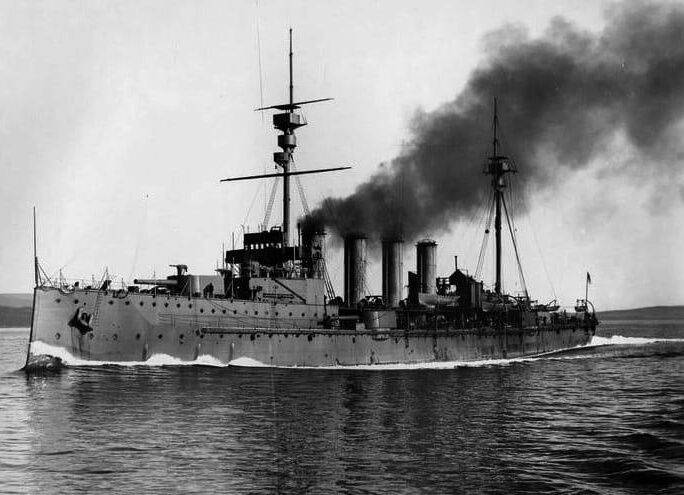
On the afternoon of 30 December 1915, HMS Natal lay at anchor in the Cromarty Firth, between Cromarty and Invergordon. The Royal Navy cruiser had returned from North Sea duties, and several civilian guests were aboard for an afternoon of entertainment.
Shortly after 3.20pm, an explosion tore through the ship. Further explosions followed, and within approximately five minutes the cruiser had capsized.
Hundreds of sailors, Royal Marines and civilian visitors died. Among them were women and children who had come aboard during the holiday period.
No German vessel had attacked the ship. The destruction was eventually attributed to an internal ammunition explosion.
A Cruiser at Anchor
HMS Natal was a Warrior-class armoured cruiser launched at Barrow-in-Furness on 30 September 1905.
At the outbreak of the First World War, she joined the Royal Navy’s Second Cruiser Squadron, part of the Grand Fleet.
The Cromarty Firth served as a naval anchorage during the war, providing shelter and supporting operations in the North Sea.
The ship had returned to the firth shortly before Christmas 1915 under the command of Captain Eric Back.
On 30 December, guests were invited aboard, including naval nurses and local civilians. A film showing had been arranged.
Some visitors were preparing to leave when the disaster occurred.
The first explosion came from the ship’s after section, where ammunition was stored. Fire spread rapidly, followed by further detonations.
The force of the explosions damaged the cruiser beyond recovery. Flames rose above the ship, and her hull rolled to port before overturning.
Men who escaped the initial explosions jumped or were thrown into the freezing waters of the firth.
Survivors Pulled From the Water
Nearby vessels, including naval ships and tugs, went to the scene to recover survivors.
Among those who escaped was Able Seaman Michael Fogarty, who later described being thrown across the deck by the force of the explosion.
More than 300 members of the ship’s company survived, many rescued from the water.
Captain Back was killed, along with the guests accompanying him.
The dead included John Henry Dods, a former Scottish international rugby player, and members of his family who had been visiting the cruiser.
Accounts of the disaster record that some of those who escaped the explosions subsequently died in the water.
The precise death toll has varied between historical records.
Invergordon Museum and Heritage Centre commemorates 421 sailors, civilians and children. The Royal Navy acknowledges estimates ranging from 390 to 421.
The differences reflect contemporary reporting, later casualty lists and the inclusion of civilian visitors.
The Investigation
Initial reports raised the possibility of a German submarine attack or an enemy mine.
Britain was at war, and the Royal Navy had already suffered losses from torpedoes and mines in home waters.
Investigators subsequently concluded that the explosion had originated within the ship.
The Admiralty considered it probable that a fire involving cordite, the propellant used in naval ammunition, had reached the after magazines.
Cordite could become unstable under certain storage conditions, creating a risk of fire or explosion.
The loss of Natal formed part of a sequence of disasters involving British warships whose ammunition magazines exploded during the First World War.
HMS Bulwark had been destroyed at Sheerness in November 1914, and HMS Vanguard would suffer a similar explosion at Scapa Flow in July 1917.
Neither of those losses resulted from direct enemy action.
The Wreck Remained in the Firth
After the sinking, the upturned remains of Natal were left in the Cromarty Firth.
The wreck was visible for years and became part of the naval landscape at the anchorage.
Salvage and clearance operations continued intermittently over several decades, with work extending into the 1970s.
Not all of the wreckage was removed. Parts remained on the seabed, and the location is still marked by a buoy.
Historical records held by the Highland Council describe successive attempts to reduce the remaining obstruction and document the condition of the wreck.
The site is recognised as a war grave.
Graves at Cromarty and Rosskeen
Some of those killed were buried in cemeteries overlooking the Cromarty Firth.
Graves at Cromarty and Rosskeen commemorate identified sailors and others whose names could not be established.
Many of the dead were never recovered.
The Commonwealth War Graves Commission records casualties from the cruiser, including men commemorated on naval memorials elsewhere in Britain.
Invergordon Museum and Heritage Centre maintains information about the ship and its crew.
The disaster has also been researched by local historians and relatives of those who died, contributing photographs, letters and family accounts to the surviving historical record.
In 2015, during the centenary commemorations, the Royal Navy’s Northern Diving Group visited the wreck and unfurled a naval ensign underwater.
Relatives travelled to Invergordon and Cromarty for remembrance events.
A Disaster in Scottish Waters
HMS Natal was destroyed while anchored in a sheltered Scottish firth, following operations with the Grand Fleet.
Her loss did not result from a naval engagement. The catastrophe began within the ship itself, killing members of her crew and visitors who had been invited aboard.
More than a century later, the remaining wreckage lies beneath the waters of the Cromarty Firth, while graves, memorials and local museum collections preserve the names and accounts of those who were aboard on 30 December 1915.
Sources
Anniversary of Wartime Tragedy in Cromarty Firth When HMS Natal Blew Up
Royal Navy, 30 December 2020
The Destruction of HMS Natal
Navy Records Society, 1 December 2015
HMS Natal — Historical Records and Centenary Commemoration
Invergordon Museum and Heritage Centre, undated
HMS Natal: Cromarty Firth — Historic Environment Record
Highland Council, undated
HMS Natal — Invergordon History
Ross and Cromarty Heritage Society, undated
The Protection of Military Remains Act 1986 (Designation of Vessels and Controlled Sites) Order 2026
UK Government, 9 March 2026
The Natal — Warship Destroyed by an Explosion off Cromarty During WWI
Cromarty Archive, undated