
Some will have escaped. Others could not. As firefighters continue working across Glenmore and Abernethy, the true cost to wildlife remains hidden beneath smoke, ash and ground that is still too dangerous to enter.
The Cairngorms wildfire began on 15 July and has affected about ten square kilometres across Glenmore and Abernethy. Firefighters, conservation workers, estate staff, gamekeepers, volunteers and helicopter crews have spent days trying to contain it, protect nearby communities and prevent further damage to one of Scotland’s most precious natural landscapes.
No reliable wildlife casualty count has yet been produced.
The fireground remains dangerous. Hotspots can continue burning beneath vegetation, roots and peat long after visible flames have diminished. Heavy machinery and helicopters are still operating, and conservation teams cannot safely walk across the full affected area to search for nests, injured animals or carcasses.
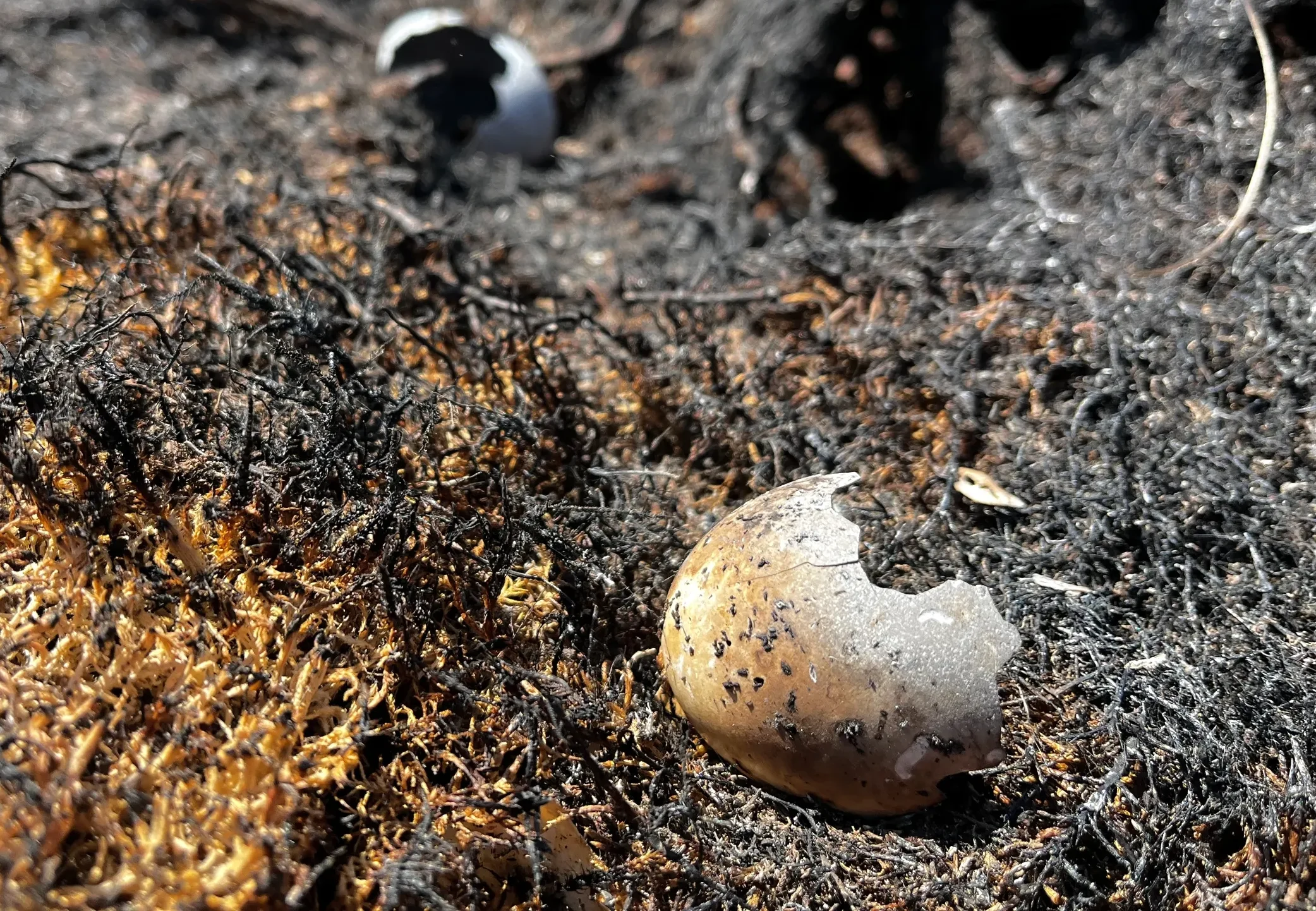
The RSPB has already reported finding charred eggshells at Abernethy. The fire arrived during the breeding season, when the woodland and moorland contained eggs, nestlings, fledglings and dependent young that could not respond as healthy adult animals might.
Some Animals Will Have Escaped
Many adult birds and mammals will have moved away from the fire.
Deer, foxes, pine martens and other mobile mammals can travel ahead of advancing flames when they have warning and a clear route. Adult birds can fly from smoke and heat. Red squirrels may move through the canopy or descend and run towards unburned woodland.
Within the wider fire area, damp ground, burns, changes in wind and natural breaks in the vegetation may also have left pockets of habitat untouched. These small refuges could have provided shelter while the fire moved around them.
Escape, however, is not the same as safety.
Animals fleeing fire may suffer burns, smoke inhalation, exhaustion and dehydration. They can be driven across roads, separated from their young or forced into unfamiliar territory already occupied by other animals. They may survive the fire itself but lose the places where they fed, sheltered and bred.
An adult bird may escape while its nest does not.
A pine marten may reach safety while the den it used is destroyed.
A red squirrel may find another stand of trees but lose the familiar routes and food sources that sustained it.
The Smallest Animals Faced The Greatest Danger
The most vulnerable animals are likely to have been those that were young, slow-moving, hidden underground or unable to travel far.
Eggs and nestlings could not flee. Recently fledged birds may not yet have been strong enough to fly beyond the smoke. Young mammals may have remained inside dens or dreys while their mothers escaped or tried to return to them.
Voles, mice, amphibians, reptiles, insects and caterpillars would have had few options.
Some may have survived beneath stones, in deep burrows, wet hollows or areas where the fire passed lightly. Burrows can offer protection from surface flames, but they are not certain refuges. Heat can penetrate the soil. Smoke can enter underground spaces. Oxygen can fall, and roots or peat may continue burning beneath the surface.
Adders, common lizards and slow-worms need time and a safe route to move. Many insects and larvae cannot move quickly enough to escape at all.
These smaller lives are often absent from the early accounting after a wildfire, yet they form the foundation of the habitat. Birds depend on insects. Predators depend on small mammals. Plants depend on pollinators and the creatures that move seeds through the landscape.
Their loss travels through the food chain long after the flames have gone.
Why Capercaillie Are A Particular Concern
Abernethy is one of Scotland’s remaining strongholds for the capercaillie, a species whose future is already fragile.
Capercaillie nest on the ground. Their eggs and chicks are therefore exposed to fast-moving fire, while young birds depend heavily on insects and the blaeberry-rich forest floor for food and cover.
Even where adult birds escaped, the fire may have destroyed nests, chicks, vegetation and insect life.
There is not yet enough evidence to say how many capercaillie were affected. It would be wrong to declare the population devastated before surveys have been carried out. It would be equally wrong to assume that the birds emerged unharmed.
The same caution applies to crested tits, Scottish crossbills, ospreys, red squirrels, pine martens and the thousands of other species found across Abernethy.
The reserve supports more than 5,000 species. Its value does not lie only in the animals whose names are familiar. It lies in the relationship between old pine trees, young woodland, heath, wet ground, fungi, lichens, insects, birds and mammals.
A forest is not simply a group of trees standing together.
It is a living arrangement built over generations.
What Recovery May Look Like
The fire will not have burned every part of the landscape with the same intensity.
In some places, flames may have moved quickly across the surface, leaving roots and deeper soil intact. Grasses and heather can begin to recover comparatively quickly after lower-severity fire. Birds may return as soon as the smoke clears, and mobile mammals may move back into surviving woodland.
Other areas may take far longer.
Old trees can be lost in minutes and require generations to replace. Deeply burned peat, ancient woodland structures and the dense ground vegetation used by insects and young birds cannot simply be restored by planting saplings.
The first green shoots should not be mistaken for full recovery.
A hillside may appear green again while the nests, fungi, insects, feeding routes and shelter that once sustained its wildlife remain absent.
The damage will unfold across different timescales. Some animals may return within days. Some habitats may need years. Severely damaged peat and ancient woodland features may take longer than a human lifetime.
There is also a loss that will be harder to see.
Conservation work carried out patiently over years can be undone by one severe fire. Habitat restoration, nest protection and efforts to rebuild rare populations depend on continuity. When the land burns, part of what is lost is the future that people had been trying to make possible.
A Landscape Defended By People Who Love It
The response to the fire has also shown how deeply this place is valued.
Firefighters have worked through smoke, heat, difficult terrain and changing winds. Conservation staff, estate workers, gamekeepers, landowners, volunteers and local businesses have helped protect homes, communities and habitat.
Their work has not been abstract.
Every firebreak cut, every water drop made and every hour spent holding the fire line has protected something living beyond it.
Residents have been able to return to Nethy Bridge after the immediate danger reduced. No human casualties have been reported, and there has been no confirmed public report of pets or livestock being killed.
That is welcome news.
It cannot yet tell us what happened to the wild animals across the burned ground.
When it becomes safe, conservation teams will begin the slower work of finding out. They will map how deeply different areas burned, examine surviving vegetation, search for nests and signs of injured or dead wildlife, and watch which species return.
Their surveys will eventually provide numbers.
Numbers will be necessary, but they will never contain the whole loss.
They will not describe the parent bird returning to a place where its nest had been. They will not show the animal that escaped into unfamiliar woodland or the small creature whose absence changes what another species can eat next spring.
For now, what can be said is limited but clear.
Many healthy adult animals will have escaped. Some young, small and slow-moving animals could not. Nests have been destroyed, habitat has been damaged and the full cost remains hidden beneath smoke, ash and unsafe ground.
The animals that survived will now need food, shelter, quiet and time.
The kindest thing the public can do is stay away from closed areas, keep dogs out of the affected ground and allow firefighters and conservation workers to continue without interruption.