
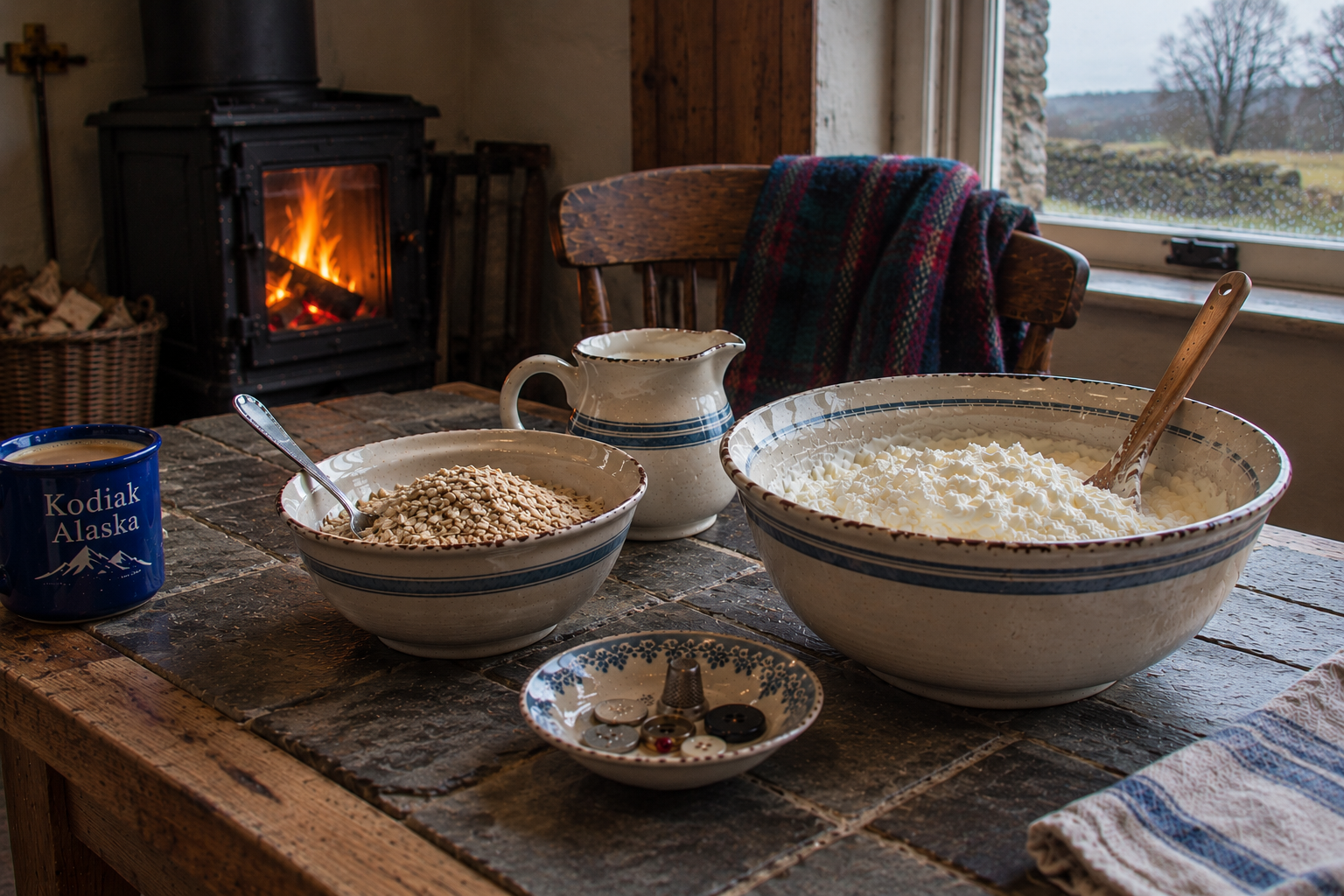
There was a time when a Scottish Halloween supper might include a large bowl of oatmeal and cream, with a silver coin, a ring, a button and a thimble hidden somewhere inside it. The object discovered on your spoon was supposed to reveal something about your future, and not every prediction was particularly welcome.
The dish was called fuarag, or Fuarag na Samhna, a traditional Gaelic preparation associated with Halloween in the Highlands and Islands. It required remarkably few ingredients, no elaborate cooking and, apart from the occasional discovery of an unexpected object, offered a relatively straightforward way to feed a gathering of family and friends.
It was also part of an older Scottish Halloween in which food, games and fortune-telling occupied a much more prominent place than commercially manufactured decorations and costumes.
Fuarag has not entirely disappeared. Its preparation survives in recorded Hebridean traditions and among Gaelic-speaking communities in Nova Scotia, where descendants of Scottish emigrants continued making it long after it became unfamiliar to many households in Scotland.
What is particularly interesting is how much of this modest dish can be recovered from surviving accounts, including photographs and recollections of Halloween celebrations on South Uist almost a century ago.
A Halloween Supper in South Uist
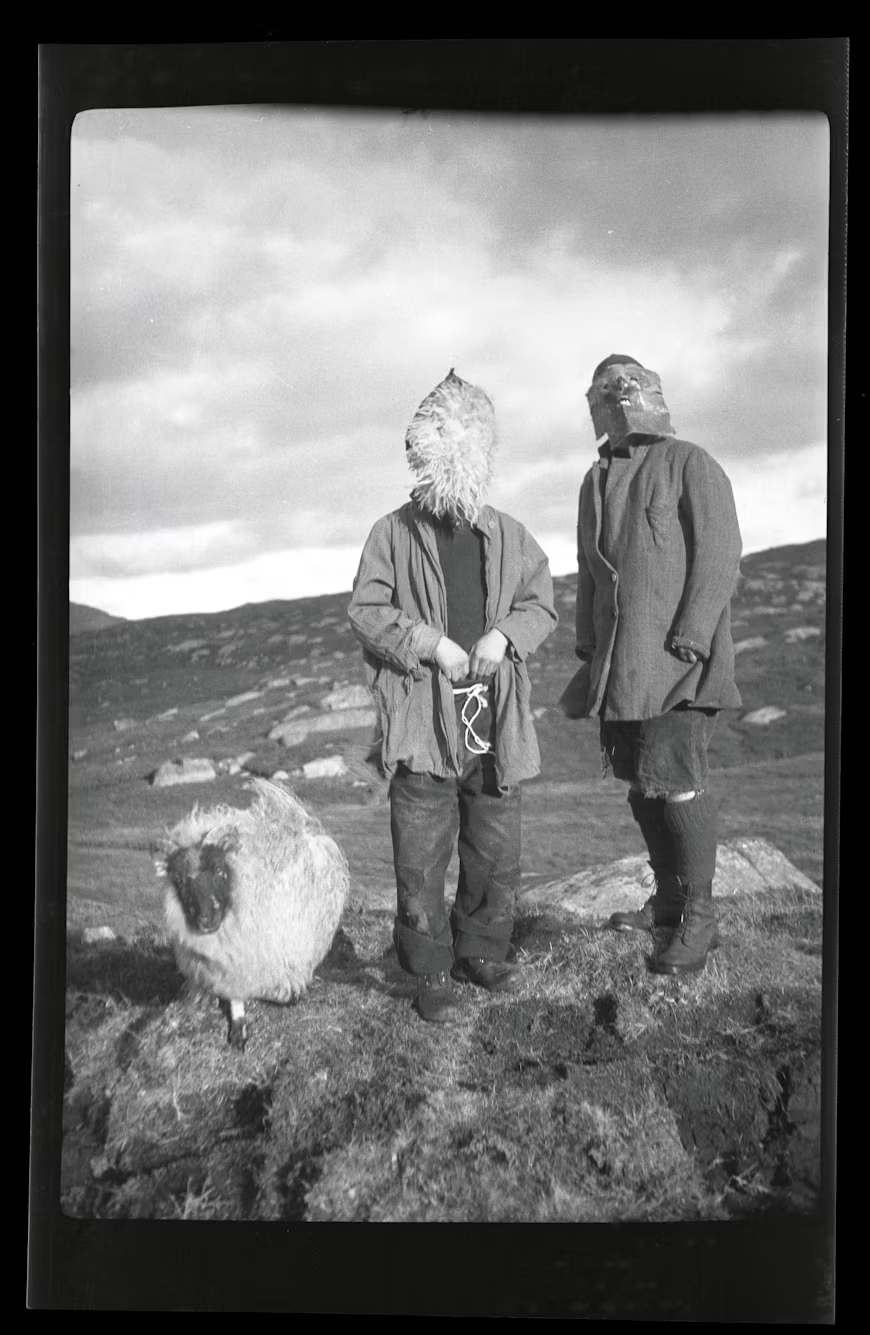
In 1932, American-born photographer and folklorist Margaret Fay Shaw was living in South Uist, recording the language, music and daily life of the Gaelic-speaking community around her.
Shaw had arrived in the island in 1929, eventually making her home with sisters Peggy and Mary Macrae at North Glendale. She recorded traditional songs, photographed local families and documented customs that might otherwise have survived only through recollection.
Halloween was one of the occasions that particularly interested her.
The children dressed as guisers, sometimes wearing sheepskins, improvised wigs made from hay and disguises fashioned from materials available around the crofts. They travelled between houses, performed songs, told jokes and received food in return.
There were apples to be caught from bowls of water, treacle scones suspended on strings and games intended to reveal the fortunes of the coming year.
There was also fuarag.
The National Trust for Scotland, which preserves Shaw’s photographic and film collection at Canna House, describes the dish eaten during these celebrations as thick cream and oatmeal containing a silver sixpence, a thimble and a button.
These objects were not ingredients. They were the means by which the household turned an ordinary bowl of food into a Halloween fortune-telling game.
Shaw’s surviving work provides an unusually valuable record of the wider celebration, including the clothing, music and people of the community. Her account is especially important because it places fuarag within an actual Scottish household tradition rather than treating it as a modern reconstruction of an ancient festival.
What Did the Hidden Objects Mean?
The meaning of each object varied somewhat between communities, although certain predictions were widely recognised.
Finding a coin generally promised money or prosperity during the coming year. A ring indicated marriage or an engagement. A button could signify financial misfortune or, in some traditions, continued bachelorhood. A thimble was commonly associated with remaining unmarried.
Historic Environment Scotland records these interpretations as part of the Scottish Samhainn tradition, while Gaelic cultural organisations in Nova Scotia document closely related customs.
The fortunes were not entirely impartial. Several predictions reflected the importance once attached to marriage and the expectation that young people would eventually establish households of their own.
A young person discovering the ring might be delighted. Someone presented with the thimble could reasonably regard the prediction as less encouraging.
But the point was the occasion itself: a gathering around a shared bowl, the anticipation of what might appear on the next spoon and the amusement produced by the results.
Among Gaelic communities in Cape Breton, visitors were sometimes offered a spoonful of fuarag at each house they entered on Halloween night. The custom continued the Scottish association between seasonal hospitality, food and fortune-telling.
The Original Ingredients
The preparation was considerably simpler than most modern Halloween desserts.
Oatmeal and cream formed the basis of the dish. The cream was beaten or churned, and oatmeal was stirred into it. In some households, the oatmeal was lightly browned beforehand to develop its flavour.
Historic Environment Scotland describes a preparation using toasted oats and whipped cream. It also records the use of a traditional wooden implement known as a frothing stick, or froh stick, to froth milk or cream.
Other surviving accounts mention sour cream, buttermilk, sugar or a little whisky. These are recorded differences between household and regional preparations, not evidence that one modern recipe can be declared the only original version.
The fundamental combination of oats and dairy, however, remained remarkably consistent.
The recipe below follows a measured preparation documented by Emily MacDonald, a Gaelic cultural researcher in Cape Breton, whose account was published in 2012.
Traditional Fuarag — The Recorded Recipe
Ingredients
2 tablespoons oatmeal
2 cups whipping cream
Traditional Halloween objects: A ring, thimble, coin and button were historically placed in the bowl for fortune-telling. These are recorded elements of the custom, not edible ingredients.
Method
Spread the oatmeal on a baking tray and place it in the oven until lightly browned. The historical recipe does not specify an oven temperature or exact toasting time, so watch carefully to prevent burning.
Pour the cream into a large bowl and beat or whisk it until it thickens.
Add the browned oatmeal to the cream and stir together.
Serve the mixture in a bowl.
This is a cream-rich preparation, reflecting the proportions recorded by MacDonald. It should not be mistaken for porridge, which is cooked with liquid, or for a modern oat dessert containing fruit, sweeteners and additional flavourings.
The recipe does not contain sugar. Sweetened versions are also historically recorded, but sugar is not part of this particular measured preparation.
An important safety note: Historically, small metal objects were stirred directly into fuarag and discovered while eating. This practice presents a choking and injury risk, particularly for children. Anyone wishing to recreate the fortune-telling game today should consider putting each spoonful on a plate to search for an object before eating. The game should also be played before party guests begin to consume alcohol.
Why Oatmeal and Cream?
Neither ingredient was unusual in the traditional Scottish diet.
Oats were among Scotland’s most important cereal crops, particularly in areas where climate and growing conditions made other grains less dependable. Oatmeal could be stored, transported and used in numerous forms, from porridge and bannocks to preparations eaten cold.
Dairy products were equally important to many Highland and island households. Milk, cream, buttermilk and butter were familiar products of domestic and agricultural life.
Fuarag brought together ingredients that were already part of everyday food preparation. Its association with Halloween came from the occasion and the objects concealed inside it, rather than from an elaborate seasonal recipe.
The Scottish National Dictionary also records a related preparation known as foorach, describing mixtures of oatmeal with buttermilk, beaten cream or whey in parts of north-east Scotland around the early twentieth century.
This is useful evidence that the underlying food was not necessarily confined to Halloween. Similar combinations of oatmeal and dairy appeared in different Scottish communities, sometimes under regional names and with differing methods.
What distinguished the Halloween version was the custom of using the dish to predict the future.
How the Tradition Crossed the Atlantic
One of the more remarkable aspects of fuarag’s history is its survival among Gaelic-speaking communities in Canada.
Scottish emigrants carried food traditions, songs, stories and seasonal celebrations with them to Nova Scotia, particularly Cape Breton, where Gaelic culture remained an important part of community life.
The Highland Village Museum in Iona, Cape Breton, has documented the Halloween custom of serving fuarag containing a ring, button, thimble and coin. It has also published a household recipe using oatmeal, cream and sugar, demonstrating how one branch of the tradition developed its own familiar preparation.
Emily MacDonald, writing in 2012, recorded recollections of families using sweet cream, sour cream, browned oatmeal, buttermilk and sometimes whisky. The variations were remembered as differences between households rather than competing claims to an official recipe.
In one family, the mother reportedly placed several buttons in the bowl and the children competed to discover the greatest number.
Another recollection describes the excitement of sharing a large bowl of fuarag, with the participants reaching in with their spoons to discover what might be waiting beneath the surface.
Such accounts show how a dish built from ordinary ingredients could remain memorable across generations.
A Scottish Halloween Worth Remembering
Much of what now fills Scottish shops ahead of Halloween bears little resemblance to the celebrations recorded by Margaret Fay Shaw in South Uist.
The children she photographed wore disguises assembled from their surroundings. Entertainment came through songs, jokes, games and visits between neighbouring households. Food was prepared from familiar ingredients, and the fortunes were discovered through small rituals that everyone understood.
Fuarag belonged to that world.
It required no elaborate kitchen equipment, no imported ingredients and no expensive decorations. Its significance lay in the gathering around the bowl and the anticipation of what the next spoonful might reveal.
For anyone wishing to recover an authentic Scottish Halloween food tradition, the oatmeal-and-cream preparation is an unusually accessible place to begin.
The recipe survives. The objects and their meanings are documented. And thanks to the work of folklorists, Gaelic cultural organisations and the National Trust for Scotland, the dish can be understood within the communities that actually made and enjoyed it.
It is a small part of Scotland’s culinary history, but a particularly appealing reminder that a Halloween treat did not always need to be sweet, brightly coloured or wrapped in plastic.
Sometimes it was simply a bowl of cream and oatmeal, with the possibility of a rather unexpected future hidden inside.
Sources
Oidhche Shamhna — A South Uist Halloween. Fiona J. Mackenzie, National Trust for Scotland, undated. Margaret Fay Shaw’s photographic and film records of South Uist Halloween celebrations in the 1930s.
https://www.nts.org.uk/stories/oidhche-shamhna-a-south-uist-halloween
A Hebridean Halloween. National Trust for Scotland, 29 October 2020.
https://www.nts.org.uk/stories/a-hebridean-halloween
Samhainn and the Scottish Traditions of Hallowe’en. Lucy Rodger, Historic Environment Scotland, 27 October 2023.
https://blog.historicenvironment.scot/2023/10/samhainn-and-the-scottish-traditions-of-halloween/
Fuarag: A Traditional Gaelic Treat for Halloween. Emily MacDonald, Air Ghleus, 29 October 2012. Source of the measured two-ingredient recipe.
https://airghleus.blogspot.com/2012/10/fuarag-traditional-gaelic-treat-for.html
Oidhche nam Bòcan — Night of the Spooks. Highland Village Museum, Nova Scotia, 17 October 2014.
https://highlandvillagemuseum.wordpress.com/2014/10/17/oidhche-nam-bocan-night-of-the-spooks/
Fuarag. An Drochaid Eadarainn, Gaelic cultural heritage project, undated. Traditional ingredients and Halloween fortune-telling objects.
https://www.androchaid.com/node/154
Foorach. Scottish National Dictionary, first published 1956, Dictionaries of the Scots Language.
https://www.dsl.ac.uk/entry/snd00070281