
Scotland has produced some excellent names for food. There is clootie dumpling, cranachan, skirlie, cock-a-leekie and the splendidly unpretentious stovies.
But surely one of the finest is rumbledethumps.
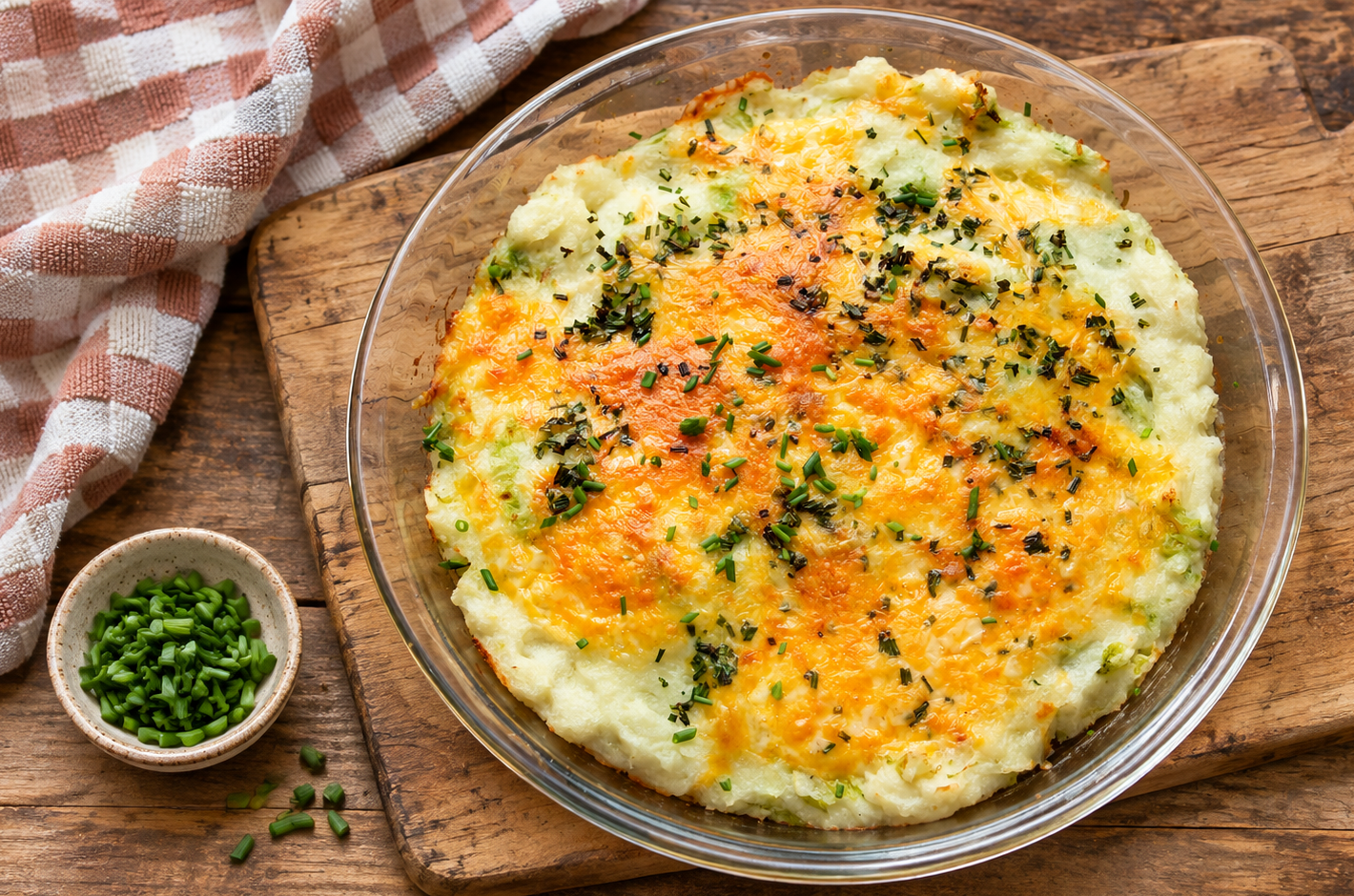
It sounds like something that happens when a cupboard collapses in the kitchen. In fact, it is a traditional Scottish Borders dish of potatoes, cabbage, onions and, in many modern versions, a generous blanket of cheese.
There is nothing particularly elaborate about it. That is largely the point.
Rumbledethumps belongs to the useful family of dishes that turn yesterday’s vegetables into something worth sitting down for. It requires no expensive ingredients, no complicated equipment and very little ceremony.
The name is memorable enough to deserve a place in every Scottish kitchen.
A Dish From the Borders
Rumbledethumps is closely associated with the Scottish Borders, where practical cooking made good use of potatoes and whatever vegetables were available.
Its relatives are found elsewhere. Ireland has colcannon, England has bubble and squeak, and Orkney has clapshot.
All use inexpensive vegetables, often left over from an earlier meal, but the methods are not identical.
Bubble and squeak is generally fried, while clapshot combines potatoes and swede. Rumbledethumps brings potatoes and greens together, often with onions, and is commonly finished in the oven.
A layer of melted or lightly browned cheese gives it an especially satisfying top.
Some traditional preparations are quite plain, containing little more than potatoes, cabbage, butter and seasoning. Others include swede, leeks, onions or cheese.
There is no single recipe that everyone in Scotland is obliged to follow.
The name is often explained as an imitation of the noise made when the ingredients are mashed and stirred together. That is an appealing interpretation, although the exact linguistic history is less certain than the story sometimes suggests.
Whatever its origins, it is difficult to imagine a more suitable name for a dish whose principal instruction is to bring everything together and give it a good thumping.
The Return of a Sensible Supper
Traditional Scottish vegetable dishes have attracted renewed attention from cooks interested in seasonal ingredients and reducing food waste.
In late October, cookbook author Ali Stoner offered a variation in Scran that uses shredded Brussels sprouts, mustard and a crisp oatmeal-and-cheese topping.
It is a reminder that such dishes do not need to remain fixed in one historical form. Their strength lies in their adaptability.
A household with leftover roast potatoes and cooked cabbage can assemble rumbledethumps with very little additional preparation.
Someone beginning with fresh ingredients can produce much the same supper.
The version below includes swede for sweetness and a little extra body. It also uses a small quantity of mustard to balance the richness of the cheese.
Neither addition should be mistaken for a compulsory ingredient in every traditional Borders recipe.
Rumbledethumps With Neeps, Cabbage and Golden Cheese
Serves: 4 as a main meal or 6 as a side dish
Preparation: Approximately 20 minutes
Cooking: Approximately 45 minutes
Oven: 200°C conventional / 180°C fan / Gas 6
Ingredients
750g (1 lb 10 oz) floury potatoes (US: russet potatoes), peeled and cut into chunks
250g (9 oz / approximately 1½ cups diced) swede (US: rutabaga), peeled and diced
250g (9 oz / approximately 3½–4 cups shredded) Savoy cabbage, finely shredded
1 medium onion, thinly sliced
60g (4 tablespoons plus ¾ teaspoon) butter, divided
90g (3¼ oz / approximately ¾ cup grated) mature Scottish Cheddar (US: sharp Cheddar), grated
1 teaspoon (5ml) wholegrain mustard (US: whole-grain mustard), optional
Salt and freshly ground black pepper, to taste
A little extra butter for greasing the baking dish
Method
Heat the oven to 200°C, or 180°C for a fan oven, and lightly butter a medium-sized ovenproof dish.
Place the potatoes and swede in a saucepan of lightly salted water. Bring to the boil and simmer for approximately 15–20 minutes, until both vegetables are tender. The swede may take slightly longer than the potatoes, which is why it should be cut into smaller pieces.
Drain thoroughly, return the vegetables to the warm saucepan and allow excess moisture to evaporate for a minute. Mash with approximately half the butter until the mixture is reasonably smooth. It need not be perfectly uniform.
Meanwhile, melt the remaining butter in a large frying pan over a medium-low heat. Add the onion and cook gently until softened, approximately five minutes.
Add the shredded cabbage and continue cooking for another five to eight minutes, stirring occasionally, until the cabbage has softened without becoming heavily browned. If the pan becomes dry, add a tablespoon or two of water and allow it to evaporate as the cabbage cooks.
Fold the cooked cabbage and onion into the potato mixture. Add the mustard, if using, and season with salt and black pepper.
Spoon everything into the buttered baking dish. Do not smooth the surface completely flat. A slightly uneven top provides little peaks that can become golden in the oven.
Scatter the grated Cheddar evenly over the surface.
Bake for approximately 20–25 minutes, until the cheese has melted and the top is golden. If the ingredients have been prepared in advance and are cold, allow additional time for the centre to become thoroughly hot.
Serve immediately.
What to Serve With It
Rumbledethumps is substantial enough to stand alone, particularly with a simple green salad or a plate of roasted mushrooms.
It also works alongside roast chicken, sausages, baked fish or a Sunday joint.
For a vegetarian supper, it needs little more than a generous spoonful on a warm plate and perhaps something sharp or pickled to cut through the richness.
The recipe is also forgiving.
Leeks can replace the onion. Kale can replace the cabbage, although it may need a little longer to soften. Leftover cooked vegetables can be used instead of preparing everything from scratch.
A small quantity of cooked Brussels sprouts can be shredded and added to the mixture, as in the contemporary variation published in Scran.
If using leftovers, cool and refrigerate them promptly after their original meal, then reheat the finished dish thoroughly. A casserole should not become an excuse to repeatedly reheat food that has already been kept too long.
A Good Dish With a Better Name
There is a tendency to treat older Scottish cooking as though its interest lies entirely in history.
But rumbledethumps remains useful precisely because it solves an ordinary problem.
A household has potatoes, cabbage, perhaps an onion and a piece of cheese. Nothing is particularly exciting on its own.
Put them together, give them a little butter and twenty minutes in the oven, and dinner begins to look considerably more promising.
There is no need to explain it in grand culinary language.
It is mashed vegetables under cheese.
Its great advantage is that Scotland had the good sense to call it rumbledethumps.