
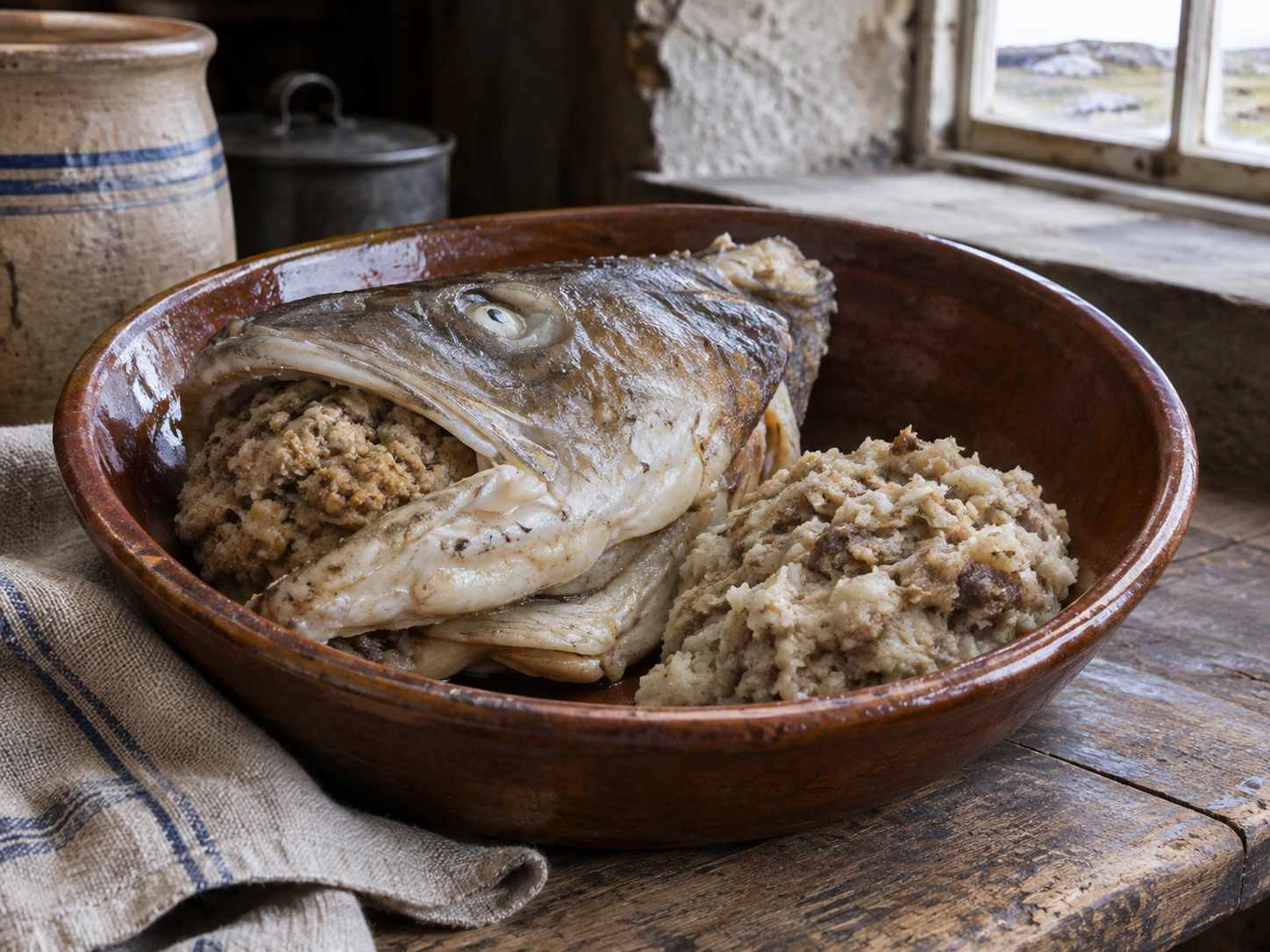
In older Shetland cooking, a fish head could become a meal in its own right. Filled with oatmeal and fish liver, then cooked, it formed a dish known as krappin, or kroppen.
Another preparation, stap, combined soft fish flesh from the head with liver and seasoning, producing a mashed dish.
Both belonged to a tradition in which the edible parts of a fish were used beyond the fillets.
The ingredients reflected the food available to fishing households in Shetland: fish from surrounding waters, oatmeal and barley from local supplies, and whatever seasonings could be obtained.
These preparations have been recorded in Shetland dialect dictionaries, accounts of island folklore and books on traditional food.
What Was Krappin?
Krappin was prepared using fish liver and meal, commonly oatmeal, mixed together and placed inside the cleaned head of a fish.
The stuffed head was then cooked, traditionally by boiling.
Recipes varied between districts and households. Some included additional seasoning, while local terminology also referred to meal preparations containing fish liver.
The fish used could include cod, haddock or smaller members of the cod family.
The preparation resembles the mainland Scottish dish crappit heid, although individual recipes and local practices were not always identical.
Both use the head as a cooking vessel for a filling based on cereal and other ingredients.
Traditional Krappin Recipe
This practical reconstruction follows the historical method of stuffing a fish head with liver and oatmeal. The proportions are adapted from a recorded Hebridean stuffed-fish-head recipe; there was no single standard Shetland formula.
Ingredients
- 1 large cod head or 3 haddock heads, properly cleaned
- 175g fresh, food-grade fish liver
- 55g medium oatmeal
- 1 dessertspoon plain flour
- Salt and freshly ground black pepper
- 1 small onion, finely chopped (optional)
- Water or fish stock for cooking
Method
- Ask the fishmonger to clean the heads, removing the gills and preparing the cavities for stuffing.
- Trim the liver and chop it finely. Combine it with the oatmeal, flour, salt and pepper. Add the onion if using.
- Mix thoroughly until the ingredients form a stuffing that holds together.
- Pack the mixture into the cavities of the fish heads without filling them too tightly.
- Secure the openings if necessary to prevent the stuffing escaping. Traditionally, flour could be used to help seal the filling.
- Place the heads in a large pan, add sufficient water or stock and bring gently to a simmer.
- Cook for approximately 30 minutes, allowing longer for larger heads. Ensure the fish and the centre of the stuffing are thoroughly cooked before serving.
The finished dish can be served with boiled potatoes and additional cooked fish.
What Was Stap?
Stap was another way of preparing the edible contents of a fish head.
The soft flesh was separated from the bones and combined with cooked fish liver.
A Shetland dialect glossary describes the dish as consisting of the liver and soft parts of the head, thoroughly mashed after the bones had been removed.
Margaret B. Stout included a recipe in Cookery for Northern Wives, first published in 1925.
A recorded version uses haddock and its liver, cooked separately and then combined with salt and pepper.
The name is related to the Old Norse word stappa, meaning to pound or mash.
Traditional Stap Recipe
Based on the preparation recorded in Margaret B. Stout’s Cookery for Northern Wives.
Ingredients
- 2 fresh haddock, with heads retained
- 2 fresh, food-grade haddock livers
- Salt
- Freshly ground black pepper
- Water for boiling
Method
- Clean the haddock thoroughly, paying particular attention to the heads and gills.
- Place the fish in a pan of lightly salted water and simmer gently until the flesh is fully cooked.
- In a separate heatproof container over simmering water, gently cook the livers until thoroughly cooked. They should release some of their natural oil.
- Remove the fish from the pan and separate the soft flesh from the heads. Carefully remove all bones.
- Mash the cooked livers with a fork, retaining the released oil.
- Add the flaked fish-head flesh to the liver and mix thoroughly.
- Season with salt and pepper. Heat the combined mixture until piping hot.
Stap was traditionally eaten hot. Some household versions incorporated additional fish flesh, depending on the size of the catch and the amount available.
Krampis: Fish Liver and Meal
Another Shetland preparation was known as krampis or liver-krampis.
Jakob Jakobsen’s An Etymological Dictionary of the Norn Language in Shetland describes it as barley or oatmeal crushed together with fish liver, particularly liver from small coalfish.
Some preparations used bursten, grain dried or toasted over a fire before being ground or crushed.
The mixture was commonly cooked in a pan.
Traditional Krampis Recipe
The following is a modern working version based on Jakobsen’s description. Historical records do not establish fixed quantities.
Ingredients
- 100g fresh, food-grade fish liver
- 50g oatmeal or barley meal
- A little water or fish stock
- Salt to taste
Method
- Gently toast the oatmeal or barley meal in a dry pan, stirring until lightly coloured.
- Chop the cleaned fish liver.
- Place the liver in a saucepan with a small amount of water and cook gently until thoroughly cooked.
- Mash the cooked liver, retaining its natural oil.
- Stir in the toasted meal, adding a little water or fish stock as necessary.
- Continue cooking over low heat, stirring until the meal has softened and the mixture becomes thick.
- Season and serve hot.
Historical descriptions also refer to related preparations in which meal and fish liver were formed into cakes and grilled.
Liver Muggies: Shetland’s Fish-Stomach Pudding
Fish stomachs were another ingredient used in Shetland cooking.
A cleaned stomach, known as a muggie, could be filled with fish liver and oatmeal or flour, seasoned and cooked.
The preparation was sometimes called liver muggies, cropping muggies or haggamuggie.
It followed a method similar to making a stuffed pudding, using a natural casing to contain the filling.
Nineteenth-century descriptions record the use of cod liver, flour and spice, while other accounts specify oatmeal and pepper.
Traditional Liver Muggies Recipe
This reconstruction follows the recorded ingredients and boiling method. Quantities are approximate.
Ingredients
- 1 large fish stomach, professionally cleaned and prepared as suitable for food
- 150g fresh, food-grade fish liver
- 50g medium oatmeal
- Salt and black pepper
- A little water if required
Method
- Use only a fish stomach that has been properly prepared for culinary use by a fishmonger.
- Chop the cleaned liver and mix it with the oatmeal and seasoning.
- Add a small amount of water if needed to bind the mixture.
- Fill the stomach loosely, allowing room for the oatmeal to swell during cooking.
- Secure the opening using food-safe cooking string.
- Place the filled stomach in gently simmering water and cook until the casing and centre of the stuffing are thoroughly cooked. The cooking time will depend on its size.
- Remove the pudding, allow it to rest briefly and slice for serving.
Historical versions could also be baked rather than boiled.
Food safety: These are historical dishes containing fish liver, which is high in vitamin A. Food Standards Scotland advises limiting liver and liver products to no more than once a week, and avoiding them during pregnancy or when trying to conceive. Fish liver and stomachs must be suitable for human consumption, obtained from a reliable food supplier and thoroughly cooked. The historical cooking methods should not be taken as a substitute for current food-safety requirements.
The Food of Fishing Households
For generations, fishing was central to the economy and food supply of Shetland.
Fish could be eaten fresh, salted, dried or preserved for later use.
The edible parts included the liver and other portions that might now be discarded during commercial processing.
Before catches reached curing stations, fishermen frequently removed the heads, livers, roes and other internal organs.
These parts could be retained by the crews for their own consumption.
Oatmeal was used in numerous household preparations because it could be stored and combined with other ingredients.
In addition to porridge and bread, meal was mixed with fish, meat and fats to make dishes suitable for cooking in a pot or over a household fire.
The use of fish heads and livers was not confined to Shetland. Comparable preparations existed in Orkney, the Hebrides and mainland fishing communities.
The Shetland names and variations form part of the islands’ recorded food history.
What the Old Dictionaries Record
Jakob Jakobsen’s dictionary preserves several terms for foods made from fish liver and meal.
The entry for krappin describes a mixture of meal and liver, sometimes placed inside a fish head before boiling.
The dictionary also records krampis, made using barley or oatmeal combined with fish liver or its extracted oil.
John Spence’s Shetland Folk-Lore, published in 1899, lists stap, liver heads, krappin and several other fish preparations among foods eaten in the islands.
Their appearance in these records establishes that the dishes formed part of the traditional vocabulary and diet before the twentieth century.
The recipes were not necessarily prepared in the same way in every household.
From Household Cooking to Food History
Krappin and stap have appeared in more recent accounts of Shetland cuisine.
Marian Armitage’s Shetland Food and Cooking, published in 2014, documents the islands’ ingredients, food traditions and household preparations.
The dishes have also been discussed by food historians examining cooking traditions around the North Atlantic.
In October 2016, demonstrations of krappin and stap were held at the Shetland Food Fair as part of a heritage kitchen organised by Shetland Museum and Archives.
These demonstrations provided an opportunity to examine the preparation of foods that had been recorded in older household and historical accounts.
Krappin, stap, krampis and liver muggies are now less commonly encountered than Shetland foods such as bannocks, reestit mutton and fish soup.
Their preparation requires ingredients that are not routinely available from supermarkets, particularly edible fish livers and properly cleaned whole fish heads.
The recipes preserve methods developed in households where the catch was used for food in several different ways.
The names, ingredients and cooking methods remain documented in Shetland’s historical records and food literature.
Sources
An Etymological Dictionary of the Norn Language in Shetland — Entries for Krappin and Krampis
Jakob Jakobsen, 1928
Shetland Folk-Lore
John Spence, 1899
Muggie — Dictionary of the Scots Language
Scottish National Dictionary, historical entries on liver muggies and cropping muggies
Cookery for Northern Wives by Margaret B. Stout
Café St Honoré, Edinburgh — Discussion of the 1925 cookbook, including its stap recipe
Seven Classic Shetland Dishes
Shetland.org — Traditional Shetland foods, including krappin and stap
Shetland’s Bookshelf: The Non-Fiction Section
Shetland.org — Marian Armitage’s Shetland Food and Cooking and Margaret B. Stout’s Cookery for Northern Wives
Book Celebrates Shetland Food and Cooking
Shetland.org, 2014 — Publication of Marian Armitage’s collection of Shetland recipes
Vitamins and Vitamin A: Dietary Advice
Food Standards Scotland — Guidance on liver consumption and vitamin A during pregnancy