
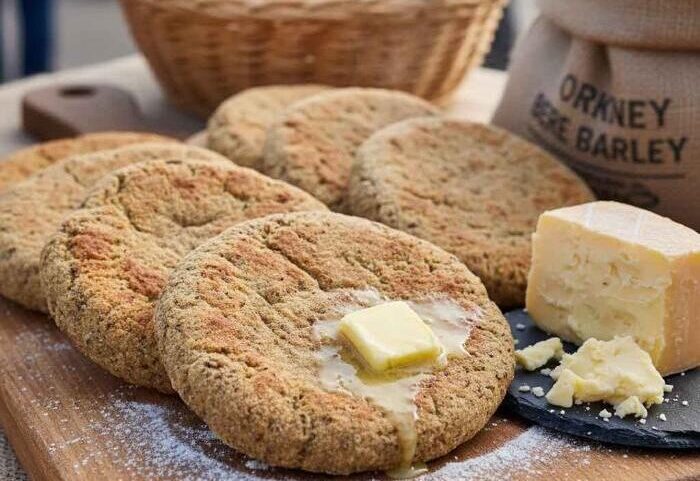
There are some Scottish foods that have survived not because somebody decided to preserve them for tourists, but because people simply kept making them.
The bere bannock is one of them.
In Orkney, where the weather has never been particularly interested in the ambitions of farmers, an ancient variety of barley has been grown for centuries. It matures quickly, tolerates difficult conditions and produces a flour with a distinctive, earthy flavour.
The barley is called bere, pronounced like the word bear, and it is one of Scotland’s most remarkable surviving food crops.
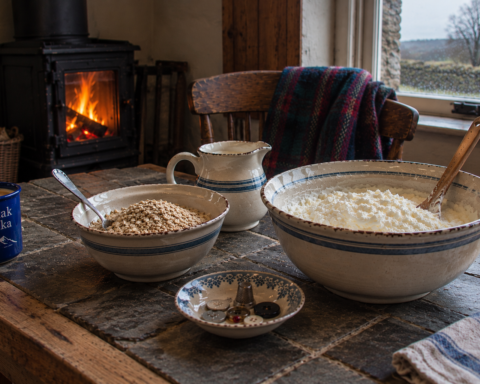
At Barony Mill in Birsay, a nineteenth-century waterwheel still turns the stones that grind it into beremeal.
The resulting flour goes into one of the simplest dishes in Scottish cooking: a round bannock, cooked on a girdle and eaten warm with butter.
No elaborate equipment is required. There is no yeast, no lengthy proving and no need to make the sort of arrangements that involve buying six things you will never use again.
The ingredients are ordinary enough, apart from the flour itself. And that is where the story becomes interesting.
A Barley That Outlived Centuries of Change
Bere is a six-row barley, meaning that its grain grows in six rows around the head of the plant.
It belongs to what agricultural scientists call a landrace: a traditional crop population that has developed through generations of cultivation and adaptation, rather than being bred as a modern uniform commercial variety.
Bere was once grown across substantial parts of Scotland.
It supplied grain for bread, porridge, brewing and animal feed, particularly in places where other cereals struggled to produce reliable harvests.
As agricultural methods changed, newer and higher-yielding barley varieties gradually displaced it.
By the end of the twentieth century, bere had survived in cultivation mainly in Orkney, Shetland and the Western Isles.
Its exact origins remain uncertain.
Bere has often been associated with the Norse settlement of Scotland’s islands, but modern genetic research suggests that its history may be considerably older.
The important point is not that every grain can be traced to a Viking farmer. It cannot. Rather, the crop represents a continuous tradition of growing, saving and replanting barley suited to Scotland’s northern conditions.
Research has identified valuable characteristics in bere, including early maturity and the ability of some varieties to tolerate difficult soils.
Scientists are now examining whether those characteristics could help develop more resilient modern barley.
An old Scottish food crop may therefore have something to contribute to agriculture’s future.
The Mill That Keeps the Tradition Alive
Barony Mill stands in the fertile district of Birsay, in the northwest of Orkney Mainland.
The present building dates from 1873, although milling in the district stretches back much further.
It is operated by the Birsay Heritage Trust and remains a working mill rather than a static museum exhibit.
Its machinery is powered by water from Boardhouse Loch. An overshot wheel drives the equipment that lifts, cleans and grinds the grain.
Bere is dried in the mill’s kiln before passing through a succession of stones and cleaning machinery.
The finished flour is called beremeal.
The mill produces different grades, but finely ground beremeal is especially suitable for home baking.
There is something satisfying about the continuity. Grain grown in Orkney is brought to a mill that still uses water power, and the resulting flour can be used to make a bannock much as earlier generations did.
It is an increasingly unusual example of a traditional Scottish food in which the crop, the processing and the finished dish remain connected to the same place.
Making Orkney Bere Bannocks
The traditional recipe published by Barony Mill is straightforward.
Ingredients — makes two or three bannocks
- 2 cups beremeal
- 1 cup plain flour
- 1 teaspoon bicarbonate of soda
- 1 teaspoon cream of tartar
- Approximately ¾ cup milk or water, adjusted as required
- A little salt, if desired
- Butter or cheese to serve
Method
Combine the beremeal, plain flour, bicarbonate of soda, cream of tartar and salt in a mixing bowl. Stir everything thoroughly so that the raising agents are evenly distributed.
Add the liquid gradually, mixing as you go, until the flour comes together into a soft but manageable dough. The amount needed may vary slightly according to the flour.
Turn the dough onto a lightly floured surface and bring it together until reasonably smooth. There is no need for prolonged kneading.
Divide the mixture into two or three portions and shape each into a flat round, approximately an inch thick.
Heat a heavy frying pan or traditional girdle over a moderate heat. The cooking surface should be dry.
Place the bannocks in the pan and cook for approximately five minutes on each side, reducing the heat if necessary to prevent the outside from browning before the centre is cooked.
The finished bannocks should be lightly browned and cooked through. Thicker bannocks may need a little longer.
Serve while still warm.
The traditional accompaniment is butter, although cheese, soup or other savoury dishes are equally suitable.
This recipe follows the proportions published by Barony Mill, which remains an excellent source for anyone interested in making bere bannocks.
What Does Bere Taste Like?
Beremeal has a character quite different from ordinary white wheat flour.
It produces a substantial bannock with an earthy, slightly nutty flavour and a texture that is less light and uniform than commercially produced white bread.
The mixture of beremeal and plain flour helps give the dough enough structure to be shaped and cooked.
Because bere is barley, it contains gluten, and the addition of wheat flour means this traditional recipe is not suitable for people who require a gluten-free diet.
The bannock is at its best fresh from the girdle. It is not designed to remain soft for days inside a supermarket packet.
A little butter, melting into the warm surface, is generally all the improvement it needs.
Why This Old Recipe Matters
The survival of bere is more than a culinary curiosity.
For centuries, people on Scotland’s islands depended on crops that could withstand their particular soils, temperatures and growing seasons.
Those crops were preserved by farmers who saved seed, adapted their methods and continued growing what worked.
That knowledge can disappear surprisingly quickly when a traditional crop ceases to be commercially worthwhile.
Scientific research has already shown that the bere populations of Orkney, Shetland and the Western Isles possess distinctive genetic characteristics. Maintaining them is therefore important for agricultural biodiversity as well as food heritage.
Barony Mill plays a practical role in that preservation by creating a continuing market for the grain.
Every bag of beremeal represents a connection between farmers, millers and households using an ingredient that might otherwise have been forgotten.
And the bannock itself remains wonderfully uncomplicated.
There is flour, liquid, a hot girdle and something good to spread on the finished result.
Sometimes Scottish culinary history does not require a banquet.
Sometimes it requires a frying pan and a kettle that is already on.