
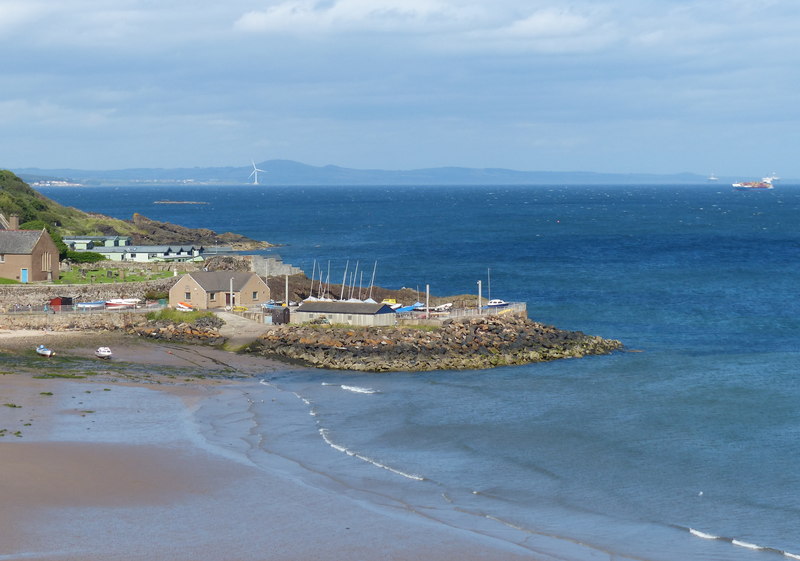
Kinghorn Harbour Beach is to lose its status as a designated Scottish bathing water after five consecutive Poor classifications, despite years of investigations, sewer improvements and enforcement action intended to address pollution entering the Fife shoreline.
The Scottish Environment Protection Agency confirmed the decision on 17 November following its assessment of water quality recorded during the 2026 bathing season.
Permanent advice against bathing will be issued, and Kinghorn Harbour will cease to be a designated bathing water until sustained improvements allow its status to be reconsidered.
The decision follows a statutory process under Scotland’s Bathing Water Regulations. SEPA says the removal of designation is mandatory after the fifth consecutive Poor classification.
It does not close the beach to public access or amount to a general prohibition on entering the water. It removes the location from the designated bathing-water system while leaving warnings concerning the condition of the water.
Modern Scot reported in July that Kinghorn Harbour had entered its fourth consecutive year of failing water quality standards, while the source of continuing bacterial contamination remained unresolved.
At that stage, SEPA had already issued precautionary advice against contact with water in Kinghorn Burn, which crosses the beach before entering the Firth of Forth.
The latest classification confirms that the improvement required to retain designated bathing-water status has not been achieved.
SEPA has published a detailed account of the investigations undertaken in the Kinghorn catchment, tracing the problem through almost a decade of engineering and regulatory work.
A modelling study completed in 2017 identified several potential pollution sources, including a combined sewer overflow at Bleaching Hill.
That overflow discharged into Lady Burn, a tributary of Kinghorn Burn, and was considered a substantial contributor to bacterial contamination affecting the beach.
The modelling suggested that removing the overflow could produce the water quality improvement needed to meet bathing standards.
Scottish Water subsequently removed the overflow in 2019.
Further investigations identified defects and incorrect connections within the local sewer network, prompting additional repairs and remedial work.
Those interventions improved some aspects of the drainage system, but the expected sustained improvement in bathing-water quality did not follow.
Approximately two years ago, SEPA served an enforcement notice requiring Scottish Water to undertake further action to address sewage pollution within Kinghorn Burn.
The water company carried out additional surveys, investigations and repairs. SEPA’s latest assessment nevertheless confirms that pollution continues to reach the burn and the bathing water.
The drainage network presents particular difficulties because large sections of Kinghorn Burn and its tributaries run underground through culverts beneath the town.
Tracing contaminated water through concealed and historically altered watercourses can require extensive inspection of underground drainage, sewer connections and individual properties.
SEPA says its evidence indicates that human sewage is the principal pollution source, with additional contributions from birds and dogs.
The regulator undertook enhanced monitoring during 2026 to examine the geographical distribution of contamination across the beach.
Ordinary bathing-water sampling generally takes place at a central location. SEPA added monitoring points at the northern end near the burn’s discharge and at the southern end of the beach.
The additional results generally showed poorer water quality near Kinghorn Burn and cleaner conditions towards the southern end.
That pattern strengthens the evidence identifying the burn and Lady Burn as routes by which pollution reaches the bathing area.
It does not establish the precise location of every remaining source within the underground drainage network.
During July, SEPA warned members of the public to avoid contact with the burn after further testing showed persistently elevated bacterial levels. Temporary warning signs were installed at beach access points.
Scottish Water acknowledged that the investigations were continuing and described the drainage problems as unusually complex.
The latest bathing-water decision comes after the regulator confirmed that 86 of Scotland’s 90 assessed bathing waters meet the required standards for 2027.
Kinghorn Harbour is among four classified as Poor, alongside Lower Largo in Fife, Dunbar East in East Lothian and Portobello West in Edinburgh.
At Lower Largo, SEPA required Scottish Water to install improved wastewater treatment facilities during the 2026 bathing season. The regulator reports encouraging initial indications but is continuing monitoring before determining whether the improvement is sustained.
Kinghorn is being treated differently because its fifth consecutive Poor classification triggers the loss of designation.
SEPA has announced a further regulatory notice requiring Scottish Water to continue investigating the pollution and undertake improvement measures.
The regulator also intends to maintain monitoring where necessary.
The beach’s removal from the designated list does not establish that the pollution problem has been resolved. Nor does it remove Scottish Water’s obligations under the regulatory action now being pursued.
The next stage depends on identifying and controlling the remaining contamination within the Kinghorn drainage catchment.
SEPA has not announced a date by which the water quality will be restored sufficiently for the beach to regain designated status.
Sources
Kinghorn (Harbour) Bathing Water 2027 — Scottish Environment Protection Agency, November 2026
86 of Scotland’s 90 Bathing Waters Meet Water Quality Standards in Latest SEPA Results — Scottish Environment Protection Agency, 17 November 2026
Update on Pollution Affecting the Kinghorn Burn — Scottish Environment Protection Agency, 31 July 2026
Kinghorn Faces Permanent Bathing Warning As Pollution Source Remains Unresolved — Modern Scot, 27 July 2026
https://modern.scot/kinghorn-faces-permanent-bathing-warning-as-pollution-source-remains-unresolved/