
They held powdered tobacco, sewing needles, spectacles, pills, perfume, photographs and reels of thread. They carried pictures of Burns Cottage, Scottish castles and seaside resorts, but also scenes from France, America, Australia and South Africa. Behind these little wooden souvenirs was an Ayrshire industry employing hundreds of people, exporting across the world and providing early work for artists who would later enter the highest ranks of Scottish art.
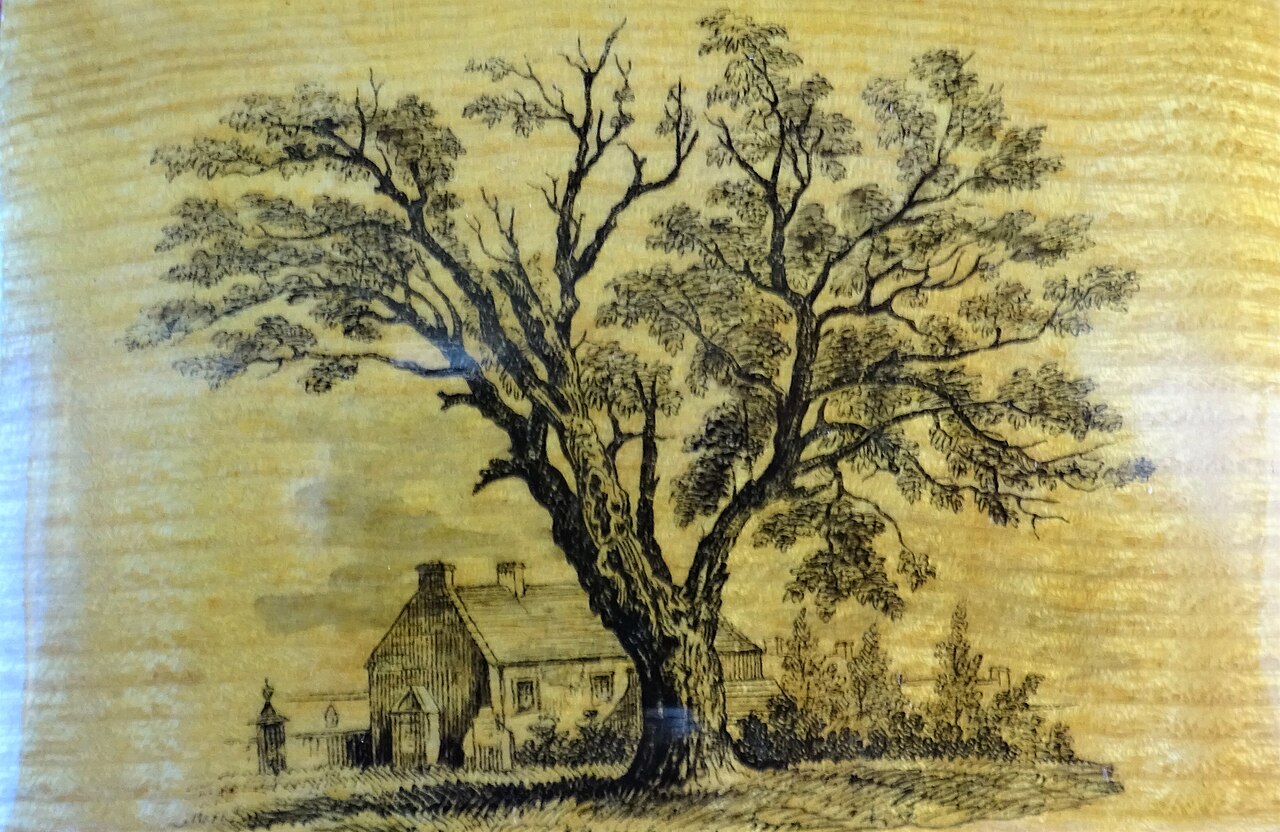
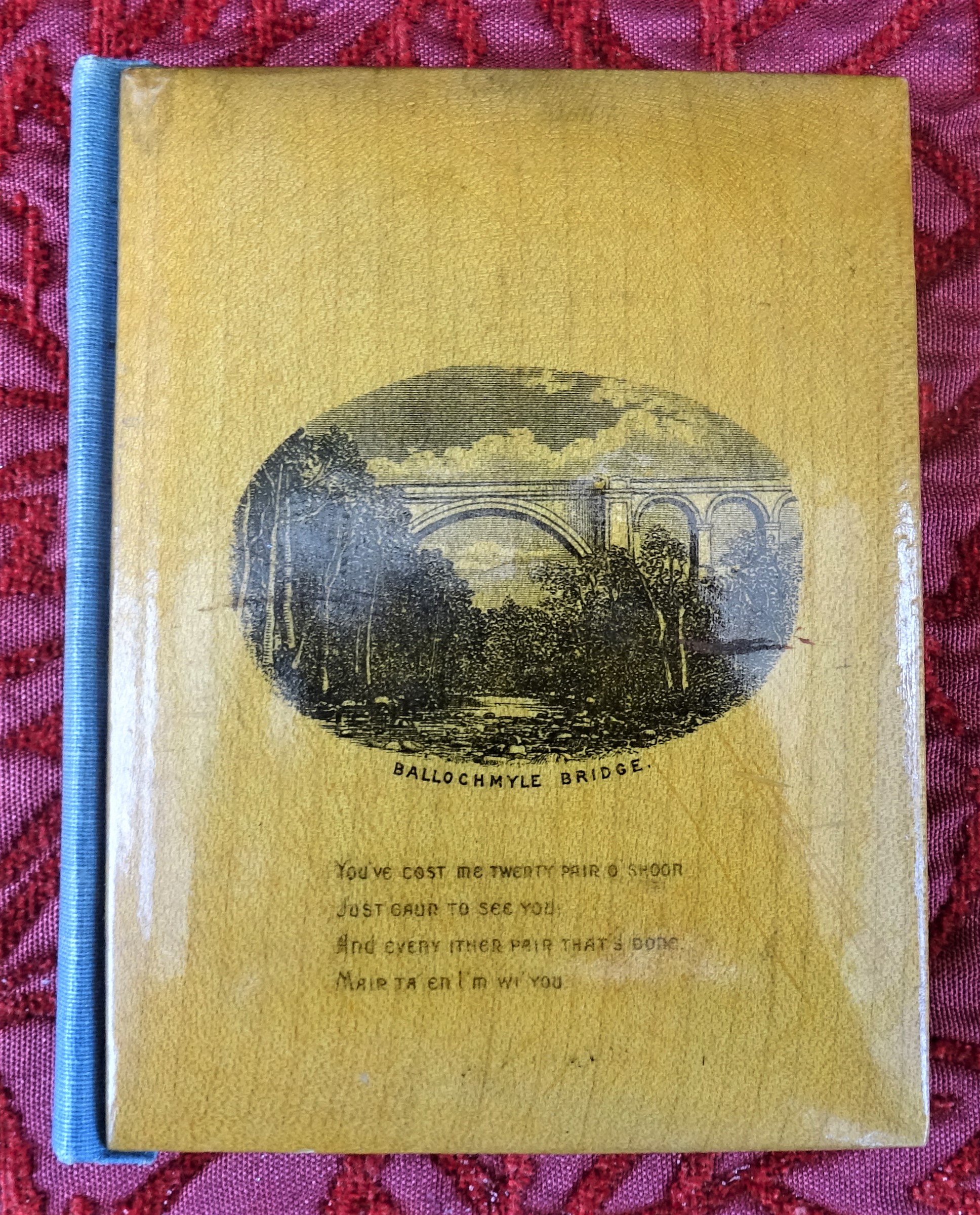
Some of the objects are scarcely larger than a matchbox. Others are round, barrel-shaped or made to resemble miniature books. There are needle cases and money boxes, spectacle cases, photograph albums, card cases, perfume containers, egg cups, napkin rings, thread boxes, sewing boxes and small wooden covers for books. Many are made from pale sycamore polished until the surface almost glows. Across their lids appear Robert Burns, Alloway Kirk, the Brig o’ Doon, castles, cathedrals, harbours, hotels, railway destinations and landscapes from places thousands of miles from the Scottish town where the objects were made. They are known collectively as Mauchline ware.
Before the railway souvenir, the Burns keepsake and the tiny tartan-covered sewing box, there was snuff. Snuff was finely ground tobacco. Instead of being smoked, a small pinch was taken and inhaled through the nose. By the late 18th century it was a common social habit among men and women and across social classes. The powder needed to remain dry and fresh, creating a practical need for a small box with a closely fitting lid.
Snuff boxes became everyday possessions. Expensive examples could be made from gold, silver or tortoiseshell, while horn, papier-mâché and wood provided less costly alternatives. Producing a good wooden box presented its own engineering problem: the lid had to close tightly enough to protect what was inside.
One of the technologies that eventually fed the Mauchline industry began far from Mauchline itself. Future Museum’s history credits James Sandy of Alyth in Perthshire, described as a bedridden mechanical inventor, with perfecting an ingenious integral wooden hinge in which the hinge formed part of the wooden construction rather than being attached separately in metal.
A joiner named Charles Stiven developed the idea commercially at Laurencekirk in Kincardineshire from about 1783. Behind him stood an unusual early investor, Lord Gardenstone, a judge of the Court of Session with an interest in commerce. Gardenstone saw that the boxes could become more than practical tobacco containers and brought in Vincent Brixhe, an artist familiar with the decorated lacquer boxes produced at Spa in Belgium. Scottish boxes began carrying painted landscapes, portraits, hunting scenes and places of historical interest. Among the customers were Queen Victoria and Prince Albert, and Charles Stiven and Sons received a Royal Warrant in 1849.
The technology might have remained concentrated in eastern Scotland had somebody not broken a box at a country house in Ayrshire.
In 1807, Sir Alexander Boswell — poet, antiquarian and son of James Boswell, the biographer of Samuel Johnson — was entertaining guests at Auchinleck House when one of them damaged the wooden hinge of a Laurencekirk snuff box. The broken box was taken to a local gunsmith named Wylie, where an employee, identified in the surviving museum history only as Crawford, repaired it. In doing so, he worked out how the secret wooden hinge had been made.

Crawford subsequently established his own wooden snuff-box business at Cumnock. An accidental repair had become an episode of informal industrial espionage.
Other makers followed. By the 1820s, more than 60 box makers were working in Scotland, according to Future Museum, with around 50 concentrated in Ayrshire communities including Auchinleck, Cumnock, New Cumnock, Ochiltree, Catrine and Mauchline. Mauchline eventually became so dominant that its name came to identify the wider class of Scottish souvenir woodware, although the technology that supported it had developed through Alyth, Laurencekirk, Cumnock and elsewhere.
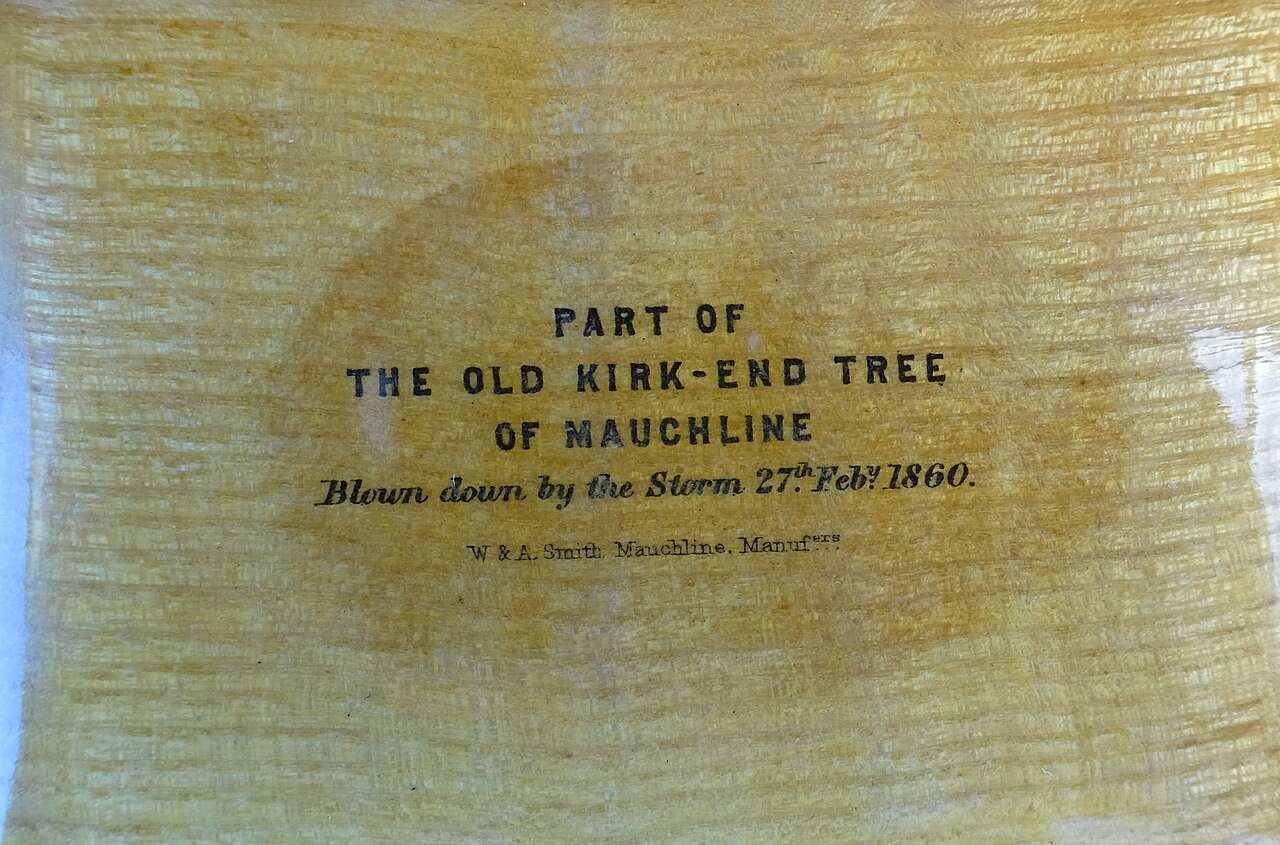
The town’s great commercial name was W. & A. Smith. The firm began with wooden hinged snuff boxes but expanded as consumer habits changed. As snuff taking declined, the manufacturers converted the same woodworking skills into almost every small domestic object that might plausibly be carried, displayed or given as a present.
W. & A. Smith opened a Birmingham warehouse and showroom in 1829. It received a Royal Warrant from William IV in 1832 and later won a gold medal at the Great Exhibition of 1851 for higher-end decorated snuff boxes.
The development that transformed the trade, however, was the ability to place pictures onto wooden objects cheaply and repeatedly. Instead of requiring an artist to paint each landscape by hand, an engraved image could be printed and transferred onto a prepared wooden surface. Finishing and successive coats of varnish protected the design, allowing a single view to appear on hundreds or thousands of souvenirs.
The technique matured as Victorian Britain became increasingly mobile. Railways shortened journeys and opened resorts, historic towns, literary landscapes and coastal destinations to a far larger travelling public. Tourism was becoming a mass commercial activity rather than the preserve of those with the money and time required for lengthy journeys by coach.
The new travellers bought things, and a Mauchline box fitted the market neatly. It was inexpensive enough to be attainable, decorative enough to serve as a present and useful enough to remain in the household long after the journey had ended. A spectacle case could carry Burns Cottage, a thread box the Burns Monument and a money box Alloway Kirk. The same Scottish manufacturers supplied English cathedrals, European landmarks and overseas scenery. An object made in Ayrshire could depict somewhere on the other side of the world.
W. & A. Smith produced views of France and Belgium and then places in North and South America, South Africa, Australia and New Zealand. Hundreds of thousands of pieces travelled through Britain and overseas during the industry’s long life. For a period, a small Ayrshire town was manufacturing the objects through which tourists remembered places far beyond Scotland.
The artistry behind them also connects Mauchline ware to the formal history of Scottish painting. Several men who decorated Scottish snuff boxes before establishing major artistic careers later became significant figures in 19th-century art.
Horatio McCulloch briefly worked as a snuff-box decorator before becoming one of Scotland’s leading landscape painters. His large Highland scenes helped establish the visual language through which generations encountered the romantic Scottish landscape. Daniel Macnee also decorated the lids of sycamore snuff boxes in Ayrshire before becoming a successful portrait painter, president of the Royal Scottish Academy and, in 1877, a knight.
William Leighton Leitch spent two years at Mauchline painting snuff boxes after the Glasgow theatre where he had worked as a scene painter failed. He later became one of Britain’s prominent watercolour teachers and served as drawing master to Queen Victoria and the royal family for 22 years. Before the academy presidencies, royal lessons and great landscapes came the little wooden boxes.
Not everything painted on them was genteel. Descriptions of surviving ware include Burns scenes, landscapes, portraits, classical figures and hunting pictures, but also risqué cartoons. The market extended from respectable domestic display into the less formal humour of the period.
Robert Burns nevertheless became one of its most valuable subjects. The connection was geographical as well as commercial. Mauchline stood within Burns country. The poet had lived at nearby Mossgiel Farm, while Burns Cottage, Alloway Kirk, the Brig o’ Doon and other places associated with his life were becoming destinations for literary pilgrims.
The manufacturers supplied them with objects in extraordinary variety. Burns’s portrait appeared on boxes. Burns Cottage appeared on spectacle cases and money boxes. Alloway Kirk, the Brig o’ Doon, the Burns Monument, Tam o’ Shanter and scenes from the growing Burns mythology were reproduced across polished pieces of Scottish wood.
Eventually the picture itself was no longer enough. The trade increasingly sold provenance alongside imagery. Objects were marketed as having been made from timber associated with the places they depicted, transforming historical and geographical association into part of the commodity itself.
Surviving pieces carry claims that their wood grew beside the River Doon. Around Stirling, souvenirs were advertised as being made from trees grown on the Field of Bannockburn, on Abbey Craig or on the slopes of Stirling Castle. The souvenir could therefore be presented not merely as a representation of a place but as a physical fragment supposedly taken from it.
One surviving object takes that appetite for relics to an extraordinary extreme. Future Museum holds a tiny oak pill box measuring only 13 millimetres high and little more than three centimetres across. Inside it is a paper inscription claiming that the wood was cut by Jean Armour Burns from the bedstead in which her husband Robert Burns died. The note identifies the Mauchline maker and records the purchaser, while a related snuff box in the same museum network survives with silver plaques declaring that it was made from part of the bed on which Burns died.
The provenance claims survive with the objects and cannot necessarily be independently proved after so much time. Their existence nonetheless records a market in which association with a famous dead writer could turn ordinary timber into a saleable relic.
At Stirling Castle, fire created another opportunity. On 18 November 1855, fire damaged the Douglas Room, historically associated with the killing of the eighth Earl of Douglas by James II in 1452. Timber said to have been recovered during the restoration was subsequently turned into souvenirs.
One survives in the Stirling Smith Art Gallery and Museum. It is a photograph album with space for 48 cartes de visite, the small photographic calling-card portraits fashionable during the Victorian period. Its covers carry a hand-painted view of Stirling Castle and a declaration that they were made from wood saved from the Douglas Room fire. The album was sold inside the restored Douglas Room itself. The building supplied the material, the historical association supplied the story and the restored room supplied the market. Damaged architecture had become retail heritage.
The industry was equally adept at converting Scottish identity into design. Tartan ware became one of its most recognisable forms. Printed tartan patterns were applied to wooden objects with sufficient precision to create a large range of named designs. This was industrial manufacture rather than an unchanged survival of Highland craft: printed paper, machinery, varnish, commercial naming and Victorian enthusiasm for tartan combined to make clan imagery portable.
The same happened with natural history. From around 1870, W. & A. Smith became a major producer of fern ware. Real ferns were commonly laid onto wooden surfaces as stencils before contrasting finishes were applied. The fashion coincided with the Victorian enthusiasm for collecting and studying ferns, turning botanical specimens into repeatable decorative motifs.
Photography was absorbed as well. Archibald Brown’s Caledonian Box Works at New Lanark specialised in applying photographs to wooden ware alongside transfer-printed products, while the Mauchline firms adapted to the same changing visual market.
Advertising followed. Thread manufacturers including Coats and Clark commissioned wooden boxes containing reels of cotton. Advertising could appear inside the lid or on the base while the exterior retained its scenic or decorative finish. A single object could combine Scottish woodwork, Burns imagery and the expanding textile economy.
Behind the polished surfaces was industrial labour. Future Museum records that Davidson, Wilson and Amphlet employed about 300 people. Around 200 were boys working from home, applying as many as 36 coats of varnish over several days. The finish preserved on surviving objects therefore concealed a labour-intensive production system extending beyond the factory walls into domestic work undertaken by children and young workers whose names largely disappeared from the historical record.
W. & A. Smith grew larger still. At its peak it employed more than 400 people, and Future Museum describes it as the largest employer in Ayrshire at the time.
Mauchline ware was an industrial product despite its later classification as decorative art. Timber had to be acquired and seasoned. Wood had to be turned, cut and fitted. Images had to be engraved and printed. Transfers required careful application. Surfaces were repeatedly finished and varnished. The completed goods then had to be catalogued, packed, transported and distributed through shops, hotels, monuments and tourist destinations across Britain and abroad. The small souvenir rested on a substantial manufacturing and distribution system.
Its decline came gradually. Glass, ceramics and other mass-produced goods widened the tourist market. German manufacturers produced competing imitation wares at lower prices. Snuff had already lost its earlier dominance, while fashions in household decoration continued to change.
The Ayrshire firms consolidated. W. & A. Smith took over Wilson and Amphlet in 1884. Davidsons ceased trading in 1889. The New Lanark box works eventually closed in 1906. Smith survived by adapting again, selling undecorated wooden objects for poker-work and handicraft classes, including supplies sent to Harrods and other London retailers. Children’s wheelbarrows and small furniture also entered the catalogue.
Then fire intervened. The Mauchline works were damaged by fire in 1933. W. & A. Smith finally closed in 1939 as Europe entered another war. The old works had been known locally as the Boxworks; the site is now occupied by Mauchline fire station.
The objects themselves dispersed much more widely and now survive in museums, private collections and auction rooms around the world. Their preservation has also depended on collectors such as Betty Meikle of Stirling, a pharmacist who was appointed OBE and assembled an extensive collection of Stirling-related Mauchline ware. When she died in 2013, she left 109 pieces to the Stirling Smith Art Gallery and Museum, including the photograph album made from timber associated with the Douglas Room.
These objects now document far more than a decorative-arts industry. They record the expansion of mass tourism, the commercialisation of Burns, Victorian enthusiasm for relics, the rise of tartan as an internationally saleable Scottish image, the early working lives of important Scottish artists, domestic and child labour, advances in transfer printing and the ability of manufacturers in a small Ayrshire town to supply customers across several continents.
They also record a Victorian desire to turn travel into possession. A landscape, literary association or historic building could be reduced to a portable object and carried home — perhaps as a picture of a cottage, a tartan box, or a piece of wood said to have grown beside the Doon, survived a castle fire or once formed part of the bed in which Robert Burns died.
Mauchline developed a commercial language for memory before the modern souvenir industry had acquired its present form, sending small Scottish-made objects into homes around the world.
Sources
Future Museum — Mauchline Ware. History of the Scottish souvenir woodware industry; snuff taking; James Sandy; Charles Stiven; Lord Gardenstone and Vincent Brixhe; the Auchinleck broken-box story; Crawford; Ayrshire box makers; artists employed decorating boxes; W. & A. Smith; international exports; workforce; home varnishing; advertising ware; foreign competition; 1933 fire and 1939 closure.
https://www.futuremuseum.co.uk/collections/arts-crafts/decorative-arts/box-ware/mauchline-ware
Future Museum — Mauchline Ware Pill Box. Tiny oak box carrying the surviving inscription that the wood had been cut by Jean Armour Burns from the bedstead in which Robert Burns died.
https://www.futuremuseum.co.uk/collections/arts-crafts/decorative-arts/box-ware/mauchline-ware/mauchline-ware-pill-box
Future Museum — Mauchline Ware Snuff Box. Early box with integral wooden hinge and silver plaques stating that it was made from part of the bed in which Burns died.
https://www.futuremuseum.co.uk/collections/people/key-people/burns/robert-burns/mauchline-ware-snuff-box
Future Museum — Fern Ware. Development from about 1870 and use of real ferns in the decorative process.
https://www.futuremuseum.co.uk/collections/arts-crafts/decorative-arts/box-ware/fern-ware
Stirling Smith Art Gallery and Museum — Mauchline Ware. Stirling tourist trade; souvenirs made from wood said to have grown at Bannockburn, Abbey Craig and Stirling Castle; development of tartan printing; Betty Meikle OBE collection.
https://www.smithmuseum.scot/mauchline-ware/
Stirling Smith Art Gallery and Museum — A Rare Stirling Gift, Mauchlineware Souvenir. Photograph album made from wood said to have been saved from the Douglas Room at Stirling Castle after the fire of 18 November 1855; 48 cartes de visite; provenance and Betty Meikle bequest.
https://www.smithmuseum.scot/a-rare-stirling-gift-mauchlineware-souvenir/
National Trust for Scotland — Mauchline Ware Threadbox. Burns Monument and Burns Cottage imagery on a thread box made from wood described as having grown on the banks of the Doon.
https://www.nts.org.uk/collections/object/object-57678
National Trust for Scotland — Flat-edged Mauchline Ware Spectacle Case. Burns Cottage souvenir inscribed as having been bought at Burns Cottage.
https://www.nts.org.uk/collections/object/object-51605
National Trust for Scotland — Mauchline Ware Box Depicting Burns House & Nanse Tannock’s Mauchline.
https://www.nts.org.uk/collections/object/object-118856
Royal Scottish Academy — Horatio McCulloch RSA. Career of the Scottish landscape painter after his early decorative work.
https://www.royalscottishacademy.org/artists/1622-horatio-mcculloch-rsa/overview/
National Galleries of Scotland — Horatio McCulloch, 1805–1867. Early employment decorating snuff boxes before his landscape career.
https://www.nationalgalleries.org/art-and-artists/29685
Royal Scottish Academy — Sir Daniel Macnee RSA. Career of the portrait painter who worked in the Ayrshire snuff-box trade before becoming president of the Royal Scottish Academy.
https://www.royalscottishacademy.org/artists/1618-sir-daniel-macnee-rsa/overview/
Dictionary of National Biography — William Leighton Leitch. Records his period painting snuff boxes at Mauchline before his later career as a watercolourist and teacher.
https://en.wikisource.org/wiki/Dictionary_of_National_Biography%2C_1885-1900/Leitch%2C_William_Leighton
Royal Collection Trust — William Leighton Leitch. Leitch’s later career as Queen Victoria’s watercolour tutor.
https://www.rct.uk/collection/exhibitions/victoria-and-albert-our-lives-in-watercolour/the-queens-gallery-palace-of/exhibition-features/william-leighton-leitch