
Before there was a kingdom recognisably called Scotland, the country south of the Forth and Clyde was divided between competing peoples, churches and rulers. They left comparatively little writing, but they left extraordinary art. Around 200 pieces of early medieval sculpture survive across southern Scotland, many scarcely studied for more than a century. A new research project is returning to them — and to a period when stone could proclaim faith, ancestry, political allegiance and power.
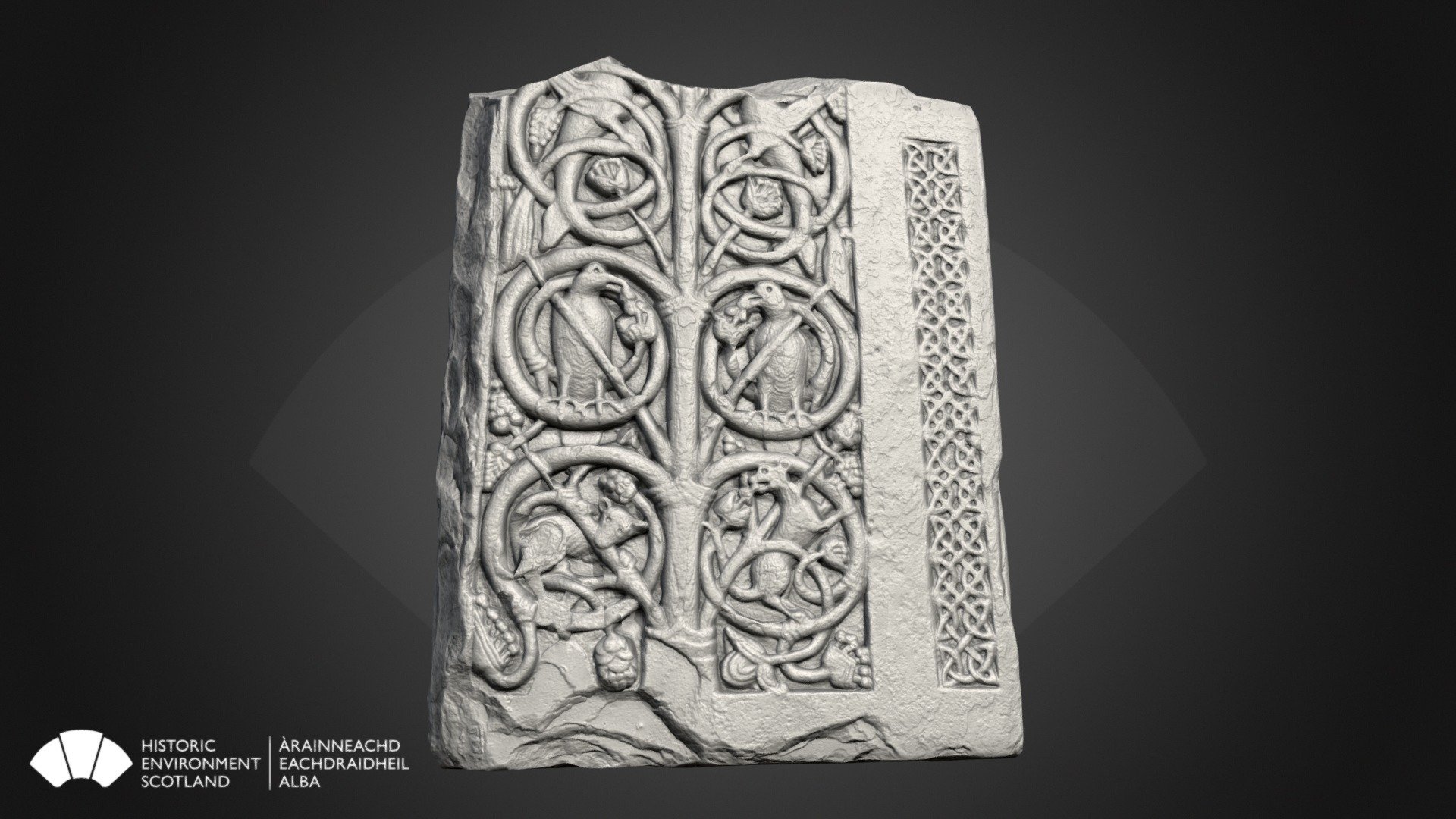
Some time in the early eighth century, craftsmen working at or for the religious community at Jedburgh carved a remarkable object from pale sandstone. What remains is incomplete, but enough survives to see the quality of the work. Vines curl across the stone. Among them are birds and small animals, including mice, feeding on grapes. Beside this inhabited foliage runs a narrow field of interlace, tightly controlled and deliberately ornamental. The surviving panel measures less than a metre across, but it belongs to one of the most sophisticated artistic traditions operating in Britain at the time.
The object is usually known as the Jedburgh Shrine. It probably formed part of an enclosed shrine or stone sarcophagus, perhaps one intended to contain the body or relics of an important religious figure. Historic Environment Scotland has suggested a possible association with St Boisil, the seventh-century prior of Melrose, although that identification cannot be established with certainty. What can be established is the artistic world to which the carving belonged. The inhabited vine-scroll, with creatures feeding among the foliage, has close parallels in Northumbrian Christian sculpture, and the Jedburgh panel has been compared particularly with the Easby Cross in North Yorkshire. :contentReference[oaicite:1]{index=1}
Centuries later, the meaning of the stone had been lost sufficiently for it to acquire a much more prosaic purpose. The carved panel was incorporated into the later medieval abbey at Jedburgh and used as a lintel above the south aisle of the choir. In the nineteenth century it was moved again. Today it is preserved in the abbey visitor centre. The survival of one of southern Scotland’s finest pieces of early medieval sculpture consequently owes something to an accident familiar throughout the history of ancient stonework: when people ceased to understand an object, they sometimes found another use for it.
That history of creation, displacement, reuse and rediscovery runs through the surviving sculpture of early medieval southern Scotland. It is also one reason the collection has never been particularly easy to understand as a whole. The stones are scattered between churches, churchyards, museums, historic monuments and stores. Some survive only as fragments. Some have been moved repeatedly. Others have lost the archaeological surroundings that might once have explained who erected them and why.
Now they are to be studied together. A new research programme, Sculpting Southern Scotland, AD 500–1100, is beginning fieldwork in autumn 2026. Coordinated by archaeologist Dr Christina Cowart-Smith, it is intended eventually to document around 200 pieces of sculpture south of the Forth-Clyde line. The Society of Antiquaries of Scotland, which is funding the initial work, says that most have not received substantial study for more than a century. Researchers intend to assemble new images and data and compare carving, motifs and relationships between sites which have often been considered separately. :contentReference[oaicite:2]{index=2}
The undertaking is unusually important because these stones come from a Scotland that did not yet exist in its later form.
Before Scotland
Between AD 500 and 1100, the territory now called southern Scotland repeatedly changed political hands. Brittonic-speaking kingdoms survived in the west. Northumbrian power extended northwards from England. Gaelic political influence expanded from the north and west. Scandinavian raiders became settlers and political actors around the Irish Sea and western seaways. Religious communities maintained connections that crossed political frontiers, while rulers used Christianity, patronage and monumental display to reinforce authority.
Our knowledge of those centuries is uneven. Written evidence exists, but compared with later medieval Scotland it is sparse and frequently comes from authors writing elsewhere, sometimes considerably later than the events they describe. Stone sculpture therefore carries a historical burden far greater than its decorative appearance might suggest. The choice of ornament, the form of a monument, the geology of the stone, the skill of its carving and its similarities to objects elsewhere can provide evidence for connections that no surviving document records.
The new project describes southern Scotland as a crossroads of cultures. That is visible at Jedburgh. The shrine panel was produced in what is now unquestionably Scotland, yet its artistic language belongs within a Northumbrian Christian world extending across what is now the Anglo-Scottish border. The modern border can therefore interfere with our understanding of the object. Its makers did not inhabit a cultural landscape divided in the same place or in the same manner as Britain today. :contentReference[oaicite:3]{index=3}
The same problem becomes unavoidable at Ruthwell in Dumfries and Galloway, where one of the greatest surviving works of early medieval art in Britain still stands.
The monument at Ruthwell
The Ruthwell Cross rises more than five metres and was created in the early eighth century, when the area around the Solway formed part of the Northumbrian political and cultural world. Its scale alone would have made it extraordinary. Its imagery makes it exceptional.
Figures from the New Testament occupy panels on its broader faces. Christ, the Virgin, St Paul, St Anthony and other sacred figures inhabit a carefully constructed visual programme. Latin inscriptions accompany the imagery. Along the narrower faces, vines coil upwards through birds and animals. Around this ornament are runes carrying passages associated with the Old English poem now known as The Dream of the Rood, in which the Cross itself becomes a witness to the Crucifixion. Historic Environment Scotland regards Ruthwell as one of the largest surviving pieces of Anglo-Saxon sculpture and one of the outstanding monuments of the early medieval church in western Europe. :contentReference[oaicite:4]{index=4}
It is tempting to view such a monument today as sculpture in the modern sense: an autonomous artwork to be examined for its craftsmanship and imagery. Its original setting would have made that separation much less obvious. Ruthwell probably stood outside rather than inside a building and may have functioned as a preaching cross. Its imagery could be encountered by people who could not read, while its Latin and runic inscriptions operated at other levels for audiences capable of understanding them. Monument, text, image, landscape and religious practice belonged together. :contentReference[oaicite:5]{index=5}
Its later treatment shows how radically attitudes towards early medieval religious art could change. In the seventeenth century, an act directed against what were regarded as idolatrous monuments led to the cross being broken. The local minister appears to have carried out the destruction reluctantly. Parts were reused as church seating or buried in the graveyard. Two large pieces were eventually moved outside in 1771, and the minister and antiquarian Henry Duncan began reassembling the monument in the early nineteenth century. The reconstruction was subsequently altered, and a replacement head was carved by a local mason. In 1887 the cross was brought inside the church, where it remains. :contentReference[oaicite:6]{index=6}
The Ruthwell Cross we encounter now is consequently both an eighth-century masterpiece and an object bearing the consequences of later Scottish religious and antiquarian history. It was created, condemned, dismantled, partly reused, recovered, reconstructed and finally protected. Its survival was never inevitable.
Art and political power
Move west to Govan and the artistic language changes again.
Modern Govan is so closely associated with the industrial Clyde that its earlier importance can be difficult to see. Long before the shipyards, however, this stretch of the river stood close to the political centre of the Kingdom of Strathclyde. Following the Viking attack on Dumbarton Rock in 870, Govan became associated with a powerful Brittonic kingdom whose rulers controlled territory extending far beyond the modern city.
The surviving sculpture is one of the clearest signs of that power. Govan Old holds an extraordinary collection of early medieval monuments dating principally from the ninth to eleventh centuries: carved crosses and cross-shafts, recumbent grave monuments, the celebrated Govan Sarcophagus and five enormous hogback stones. The collection is among the most important bodies of early medieval sculpture surviving in Scotland. :contentReference[oaicite:7]{index=7}
The hogbacks are particularly strange objects. Their curved profiles resemble the roofs of buildings, and their surfaces can carry architectural and animal ornament. Examples are concentrated principally in northern Britain and are strongly associated with areas affected by Scandinavian settlement and cultural influence. Govan possesses five, the largest surviving group in Scotland. Their presence beside monuments belonging to a Brittonic Christian centre demonstrates the difficulty of dividing early medieval culture into neat ethnic categories. Artistic forms travelled. Communities borrowed. Political alliances shifted. People who encountered one another through warfare also traded, married and exchanged visual ideas. :contentReference[oaicite:8]{index=8}
The Govan Sarcophagus belongs to another expression of authority. Cut from a single block of stone, it carries interlace and figurative imagery, including a mounted warrior. Its exceptional scale and craftsmanship have encouraged its interpretation as a monument connected with the ruling elite. Taken together, the Govan stones indicate a high-status burial ground and an ecclesiastical centre closely connected with power. These were not simply grave markers placed by anonymous communities. Monumental sculpture helped establish who deserved to be remembered and how that memory should appear in public.
By around the eleventh century, the political world that had supported this artistic tradition was disappearing. Strathclyde was absorbed into the developing Scottish kingdom, while Glasgow emerged as a major ecclesiastical centre. Govan’s political centrality faded. The stones remained. :contentReference[oaicite:9]{index=9}
Stone could speak where documents were silent
This is why the proposed survey of southern Scotland’s sculpture has significance beyond cataloguing. If two fragments at distant sites employ closely related ornament, researchers can ask whether the same workshop, craftsmen or ecclesiastical network was involved. Geological examination can help establish whether stone was quarried locally or transported. Changes in carving technique can reveal different periods of activity at a site. The distribution of particular monument types can suggest where ideas travelled and where wealthy patrons were able to commission specialist work.
The imagery itself can reveal intellectual connections. The animals feeding among vines on the Jedburgh shrine were not casual decoration. In Christian art, inhabited vine-scrolls carried associations with creation, salvation and the Eucharist. Closely related ornament occurs at Ruthwell, where creatures move through the curling vegetation on the sides of the cross. Such similarities place southern Scottish monuments within a visual vocabulary extending across early medieval Northumbria and beyond. :contentReference[oaicite:10]{index=10}
That vocabulary was international. Early medieval Britain was not artistically isolated. Christian imagery and ornamental traditions circulated through manuscripts, metalwork, ivory, stone and textiles, transmitted along religious and political networks connecting Britain and Ireland with continental Europe and the Mediterranean Christian world. A sculptor in southern Scotland did not need to have travelled to Rome to participate in that culture. Designs could move through books, portable objects, travelling clergy and other craftsmen.
The stone monuments therefore preserve evidence of people looking outward as well as inward. Their art was capable of announcing local identity while simultaneously demonstrating membership of a much larger Christian culture.
What later Scotland did to the stones
The survival of this material also exposes a less comfortable history. Once the political and religious systems that created the monuments disappeared, many stones lost their original meanings. A beautifully carved fragment could become useful masonry. A cross could be broken during religious reform. A grave marker could be moved because it obstructed a later building. Antiquarians might rescue an object while simultaneously removing it from the place that explained it.
Jedburgh’s shrine fragment becoming a lintel is a particularly vivid example. The people who incorporated it into the later abbey preserved an early medieval artwork, but they also transformed it into architecture. Whether they recognised its age or significance at that stage is uncertain. What survives today is consequently both an artwork and evidence of changing attitudes towards the past. :contentReference[oaicite:11]{index=11}
At Ruthwell, destruction was ideological rather than merely practical. The seventeenth-century attack on the cross arose from a religious culture that interpreted monumental imagery very differently from the Christian society that had erected it approximately nine centuries earlier. Henry Duncan’s nineteenth-century reconstruction belonged to another intellectual world again, one increasingly interested in recovering early national and ecclesiastical antiquities. Each generation altered the physical object according to its own understanding of what the stone represented. :contentReference[oaicite:12]{index=12}
Other stones were simply overlooked. When nineteenth- and early twentieth-century antiquarians travelled through Scotland recording carved monuments, they often encountered fragments incorporated into church fabric, lying in graveyards or held locally. Their drawings, rubbings, photographs and written descriptions sometimes provide evidence for objects that have subsequently deteriorated, moved or disappeared.
The new research project is therefore partly a race against another period of change. Many early carved stones remain in or beside churches. Scotland is currently experiencing widespread church closure and disposal, and the Society of Antiquaries has identified uncertainty over what will happen to historic objects associated with buildings that are sold or change use. For sculpture that has survived centuries because it happened to remain in a church or churchyard, the future of the building can become the future of the object. :contentReference[oaicite:13]{index=13}
The problem with calling all of this Scottish art
There is a useful historical paradox in assembling these objects as the art of early Scotland. Much of it was created before Scotland possessed the political boundaries or national identity through which it is now viewed.
The Ruthwell Cross was made in Northumbrian territory. Govan’s monuments belonged to the Kingdom of Strathclyde and a Brittonic political tradition. The Jedburgh sculptures emerged from a religious and artistic environment with strong Northumbrian connections. Scandinavian influence later entered the visual culture of western and southern Britain. Other sites preserve different mixtures again.
To call all of this simply Scottish can conceal the history that makes the material important. These works belong to the history of the land that became Scotland, but their makers inhabited kingdoms whose frontiers crossed the modern border and whose languages, loyalties and political identities do not fit comfortably inside later national categories.
The sculpture records that complexity more faithfully than a modern map does. A vine-scroll does not stop at the border. Neither does a carving technique. A monument type appearing in Govan and northern England can record connections that political histories written centuries later tend to separate.
What eventually became Scotland was formed partly through the destruction, absorption and transformation of these earlier political worlds. Their written archives are slight. Their sculpture survived them.
The artists whose names disappeared
Almost none of the people responsible for this work can be named. Yet the stones themselves show that highly trained specialists existed. The planning necessary to cover a monumental cross with coherent figurative scenes, inscriptions and ornament was considerable. The sculptor had to understand the material, prepare the design, transfer complex patterns to stone and execute them without the possibility of simply replacing an expensive block after a serious mistake.
Differences between hands may eventually allow researchers to identify groups of work produced by particular workshops or even individual carvers. That does not restore their names, but it begins to restore artistic agency. Early medieval sculpture can otherwise acquire the misleading appearance of having been produced by cultures rather than people.
Someone designed the mice among the vines at Jedburgh. Someone decided how deeply their bodies should emerge from the sandstone and how the vegetation should curl around them. Someone at Ruthwell organised biblical figures, Latin text, runic poetry and inhabited vine-scroll over a monument towering above its audience. Someone at Govan cut a block of stone into a form intended to perpetuate the memory and status of a dead person.
Those decisions are the history of art as surely as the work of painters whose signatures survive from later centuries.
A different beginning for Scottish art
Scottish art is often encountered through periods in which artists and patrons can be named: medieval church architecture, Renaissance court culture, eighteenth-century portraiture, nineteenth-century landscape painting or the Glasgow movements of the modern era. The early medieval stones belong to a much less comfortable history because almost everything that usually accompanies an artwork has disappeared.
We often do not know who commissioned them. We do not know who carved them. In many cases their original location has been lost. Their colour, if they were painted, has disappeared. Their surrounding buildings may have vanished completely. Some survive as fragments too small to reconstruct confidently.
Yet the surviving pieces show that the visual culture of early medieval southern Scotland was neither crude nor provincial. Ruthwell demonstrates intellectual and artistic ambition on a European scale. Jedburgh preserves the work of carvers operating within a sophisticated Northumbrian tradition. Govan reveals a later centre in which Brittonic political power, Christianity and Scandinavian influence produced one of Britain’s most distinctive groups of funerary monuments.
The approximately 200 sculptures now being brought together by researchers will not produce a single story of early Scottish art. They are more valuable precisely because they cannot. They belong to different kingdoms, different centuries and changing religious and political environments. Some were monuments to rulers. Others belonged to churches. Some survive almost complete.